

As 15,000–20,000 graduates enter the workforce every year, skill development is pushed as an alternative – but where are the opportunities for a growing workforce?
Arenjungla Kichu
Mokokchung | 22 July
For years, a government job has been seen as the most secure career option for many young Nagas. But with thousands of graduates entering the job market every year and limited government vacancies, Nagaland is now looking towards skill development and entrepreneurship as alternatives.
The question, however, remains: if the government job model cannot absorb the growing workforce, what comes next?
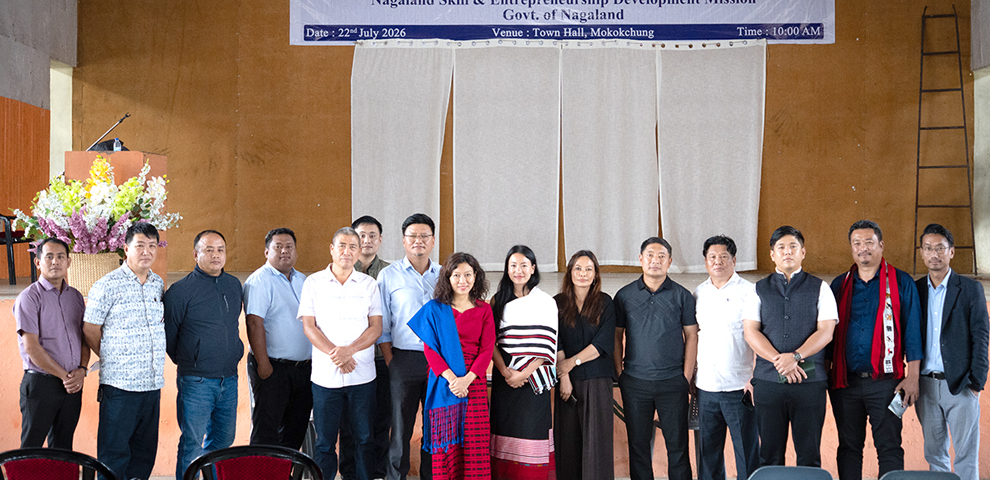
Meripeni Ngullie, Under Secretary and Project Lead of the Nagaland Skill & Entrepreneurship Development Mission (NSEDM), highlighted the scale of the challenge during a one-day sensitisation programme on skill development organised by the Ao Officers’ Telungjem (AOT) in collaboration with NSEDM at Town Hall, Mokokchung.
Ngullie said around 15,000 to 20,000 graduates enter the job market every year while government employment opportunities remain limited.
She pointed out that more than 16,000 candidates appeared for the NPSC preliminary examination in 2025 for just 96 vacancies, showing the intense competition around government jobs.
Nagaland’s unemployment rate among the 15–29 age group stands at 16.7 per cent, she said, with educated youth forming a major share of those seeking employment.
But Ngullie said the issue is not only the number of candidates competing for government posts.
“The question is what happens to the other candidates who spend years preparing for one vacancy,” she said, pointing out that prolonged preparation for competitive examinations can result in loss of work experience, income opportunities and professional growth.
Ngullie said employers today look for practical skills, work experience and adaptability, while many educated job seekers continue to face difficulties because of the gap between academic qualifications and industry requirements.
She said skill development has to go beyond obtaining certificates and must lead to actual participation in the workforce.
NSEDM, she said, has been working to provide training opportunities across various trades and connect trained youth with employment opportunities.
However, while skill development is being promoted as an alternative to government employment, the larger challenge remains whether Nagaland has enough opportunities to absorb the workforce it is preparing.
The program highlighted several examples of youth who have built careers through skill-based opportunities. Success stories included individuals working with organisations such as Qatar Airways, those employed in the hospitality sector in Delhi, and young people who have pursued opportunities in Japan.
Others shared experiences of starting their own enterprises, including repair workshops and service-based businesses, demonstrating how skills can create pathways beyond conventional employment.
These examples show that skill development can create new opportunities. However, they also highlight the challenge before the state – whether such opportunities can increasingly be created within Nagaland or whether skilled youth will continue to look outside the state for employment.
Speaking at the program, Deputy Commissioner of Mokokchung Ajit Kumar Verma, IAS, said Nagaland’s growth cannot depend only on government schemes and government employment.
Verma described skill development as “value addition to human resources” and said the state needs a favourable environment where skills can contribute to economic growth.
He said three elements are necessary for successful skill development – a supportive environment, proper infrastructure and consistency.
The DC said responsibility does not lie only with the government, adding that families, schools and communities also have an important role in encouraging young people to develop skills and pursue different career options.
“Proper guidance is not enough,” he said, stressing that motivation, willingness and the desire to improve must also come from individuals.
Verma pointed to the mismatch between education and employment, saying many graduates possess degrees but lack the practical skills required in the workplace.
He said sectors such as agriculture, traditional crafts and local enterprises have potential but require better systems, markets and infrastructure.
Calling for stronger technical institutions, Verma stressed the need to strengthen Industrial Training Institutes (ITIs) with modern infrastructure, new trades and qualified instructors capable of preparing youth for changing employment demands.
Earlier, Imosong Imsong, Joint Commissioner of Taxes and Vice President of Ao Officers’ Telungjem, said the program was organised in response to concerns over growing educated unemployment among youth.
The program also featured experiences from entrepreneurs and skilled professionals, including Limamatsung and Akumtemsu of L&A Repair & Services and drone mapping professional Kütholüzo Gideo Veswüh, who shared their experiences in building careers through skills and entrepreneurship.
As Nagaland attempts to move away from a government-job-dependent employment model, the challenge ahead is not only training young people with new skills, but ensuring that those skills find a place in the state’s economy.
The success of Nagaland’s skill push may ultimately depend not only on how many young people are trained, but on whether the state can create enough opportunities for them to stay and work.