
After five decades of work in traditional weaving, skill development and livelihood activities, society partners with ALEAP to expand women’s entrepreneurship and market access
What began in 1976 as an effort by a group of women to preserve traditional Chakhesang attire while earning a livelihood through weaving has, over five decades, grown into a wider initiative spanning skill development, livelihood activities and women’s economic participation.
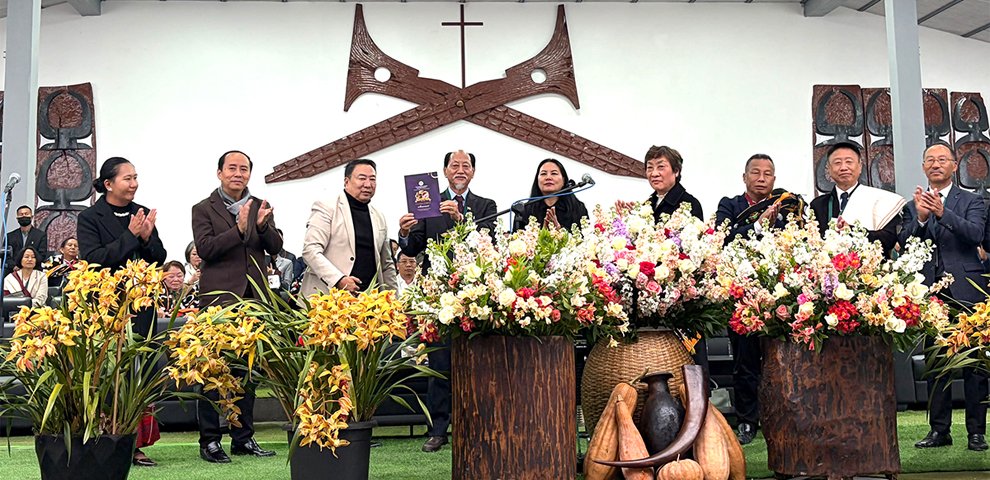
The Chakhesang Women Welfare Society (CWWS), which marked its golden jubilee at T Chikri, Pfutsero, on November 21, began with traditional looms and the belief that weaving could provide women with an income while keeping their cultural attire alive.
In an interview with The New Indian Express published in March 2026, CWWS Executive Director Nezelü Nyekha said the organisation gradually expanded into other small-scale entrepreneurial activities to reach more women. She estimated that around 60,000 Chakhesang women were associated with the initiative, directly or indirectly.
As the number of women involved in weaving and production increased, CWWS established the Chakhesang Women Multipurpose Cooperative Society to manage the business side of the activity, including taking orders and connecting weavers with markets.
The products have expanded beyond traditional Chakhesang shawls to include contemporary items such as bags, aprons and curtains. The organisation also has a training centre in Pfutsero, where women receive training in weaving and tailoring.
A significant milestone came in 2017 when Chakhesang shawls received Geographical Indication (GI) registration, with CWWS listed as the applicant in the official GI Registry. The registration formally recognises the shawls’ geographical identity and provides a framework for protecting the product’s name and reputation.
The society’s work in handloom development also received support through a project funded by the Department of Science and Technology. Listed on the India Science, Technology and Innovation portal, the project titled “Socio-Economic Upliftment of Tribal Women Through Improvement of Handloom Weaving and Commercialisation of GI Shawls” began in 2019, with a budget of Rs 52.8 lakh and CWWS as the implementing agency.
Beyond weaving, the organisation has been involved in other livelihood activities, including food processing and agriculture. Addressing the golden jubilee, Chief Minister Neiphiu Rio said CWWS had facilitated the formation of 586 self-help groups and joint liability groups and provided skill development and livelihood training to more than 20,000 women and youth.
He also referred to the society’s work in tailoring, weaving and food processing, as well as an initiative involving the integrated development of persimmon and kiwi orchards with 200 farmers.
The golden jubilee also marked the beginning of a new partnership, with CWWS signing a Memorandum of Understanding with the Association of Lady Entrepreneurs of India (ALEAP), Hyderabad, to promote women’s entrepreneurship in Nagaland and other Northeastern states.
According to the agreement, the two organisations will collaborate on entrepreneurship training, technical guidance, enterprise creation and expansion, capacity building and market linkages. The proposed areas of cooperation include food processing, agriculture and allied sectors, handloom, handicrafts, textiles, bamboo, cane and organic products. The MoU also envisages support for common facility centres, incubation facilities, enterprise clusters and access to institutional finance and government schemes.
Guest of honour Mercy Epao, Joint Secretary in the Union Ministry of Micro, Small and Medium Enterprises, urged CWWS to develop into a resource centre for entrepreneurs, potentially providing assistance with project reports, capacity building and knowledge-sharing.
She identified unreliable power supply and limited market access as challenges facing businesses in Nagaland, and stressed the importance of product testing, certification, packaging and branding to help local enterprises reach wider markets.
Referring to the new partnership, Epao proposed developing at least 10 women entrepreneurs with a combined turnover of Rs 10 crore. The proposal was made as a suggested target at the jubilee, rather than an announced commitment by CWWS.
The partnership comes at a time when the society is looking to build on five decades of work in skills and livelihood development. The next challenge will be to translate these networks and skills into stronger enterprises, improve access to markets and ensure that women can secure more dependable incomes from their work.
For an organisation that began with traditional weaving as a means of livelihood and cultural preservation, its next phase will be measured not only by the number of women it reaches, but also by the economic opportunities those women are able to sustain.