
CKL flags growing use of borrowed words and generational disconnect from ancestral land following participation at Samvaad 2026
As borrowed words increasingly replace indigenous expressions in everyday conversations, the Changki Kaketsüri Longjem (CKL), the village students’ union, is turning to social media to encourage younger generations to learn and reclaim their mother tongue, Changki-o.
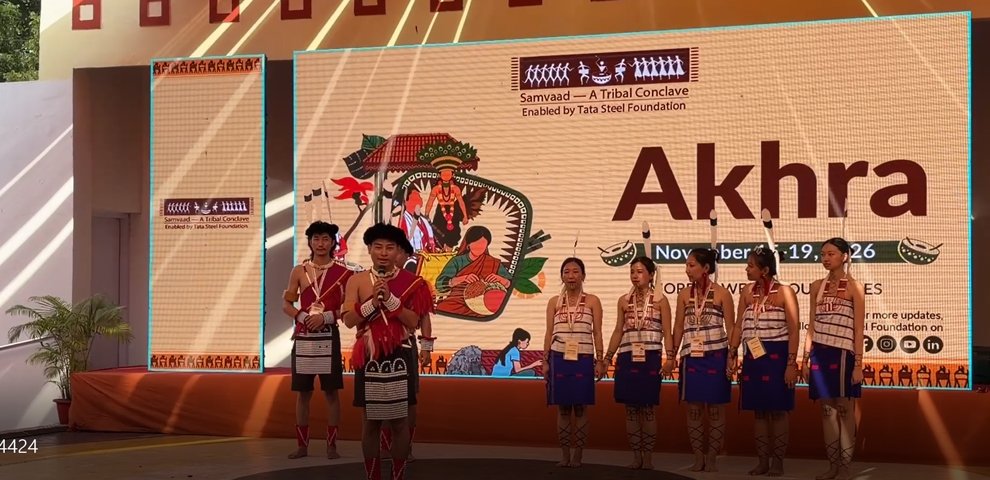
The initiative was among the experiences shared by nine CKL representatives at the 13th edition of Samvaad 2026, a five-day tribal conclave organised by the Tata Steel Foundation in Jamshedpur from November 15 to 19.
Representing the Ao Naga community of Changki village, Mokokchung district, the nine-member group participated in the Akhra discussions, including a session themed “Reimagining Identity to Connect the Dots”, where they highlighted the role of younger generations and digital platforms in preserving indigenous languages and identity.
Speaking about the initiative, Tiapong Tzudir, one of the participants, said the union had been using digital platforms to teach Changki-o through simple everyday expressions and words shared on social media.
From teaching people how to count numbers in their mother tongue to learning everyday expressions and traditional ways of addressing one another, these initiatives aim to make language learning more accessible, particularly for younger generations.
Tzudir emphasised that language preservation need not always depend on large institutional efforts, but could also begin with small, consistent initiatives within the community.
The discussions also touched upon the significance of ancestral land among tribal communities. The Changki representatives shared how land is not merely a geographical territory or something defined by its size and measurements, but an integral part of their identity, history and belonging.
For the community, the relationship with ancestral land extends beyond ownership to encompass memories, traditions, connections with nature and cultural inheritance passed down through generations.
Speaking to MT after the conclave, CKL President Taliyanger Changkiri, Milotsüng highlighted the growing generational disconnect from ancestral land, observing that while older members of the community could identify the exact location of boundary stones even beneath thick vegetation, younger generations had largely lost touch with these markers.
However, he said a gradual shift was emerging, with rising unemployment prompting some young people to recognise the value of their ancestral land and explore farming and other land-based livelihoods. Some have begun returning to trace and reclaim their ancestral lands.
Changkiri also pointed to the gradual disappearance of indigenous vocabulary from everyday use, with borrowed words increasingly becoming commonplace. He cited Chaken, referring to the distinctive touch or skill of a cook, and Süra, referring to something edible, typically a fruit, as examples of Changki-o words that are difficult to translate directly into other languages.
He also highlighted how the expression Samdang Pelaro, literally meaning “very happy”, is frequently used to express gratitude, while the more precise indigenous expression for “thank you”, Tiaroh, is often overlooked.
Similarly, the indigenous word for pear, Sololo, is increasingly being replaced by the borrowed term Naspati.
“If the Changki Kaketsüri Longjem were to halt its language preservation initiatives today, in twenty years we would likely be speaking a diluted version of Changki-o, heavily patched with Nagamese and English borrowings,” Changkiri said.
He added that traditional forms of addressing elders, peers and friends through kinship and relational terms such as Koba and Küti, which were once declining in popularity, were now witnessing a gradual revival as the younger generation was being encouraged to reclaim them.
Reflecting on the experience at Samvaad, Tzudir spoke about the opportunity to encounter indigenous communities and histories they had never previously known.
“We heard about tribes we had never heard of before and got to listen to their stories and experiences. That was very impactful. There are so many opportunities and platforms across communities, and we really need to start looking at them more, participating and making use of these spaces,” Tzudir said.
He noted that such platforms offered an opportunity not only to share one’s own culture and experiences but also to learn from the diverse histories and knowledge systems of other indigenous communities.
While nine CKL representatives participated in the Akhra segment, other representatives from Nagaland were also present across different segments of Samvaad, including the traditional cuisine showcase.
The 13th edition of Samvaad brought together indigenous communities from across India for conversations on tribal identity, governance, ecology, education, language preservation and community aspirations.