

Chief Secretary flags need to plug leakages and improve coordination; Finance Commissioner reminds officials that public resources belong to the people
With more than 85% of its revenue coming from the Centre, Nagaland faces the challenge of strengthening its own resources while ensuring that the money available to the government is used effectively to improve public services and support development.
These challenges featured among the issues raised at the first Annual Finance Department Conclave and Team Synergy Day 2026, where Chief Secretary Sentiyanger Imchen called for a clear roadmap to augment resources, plug loopholes and leakages, and ensure effective delivery of services to citizens.
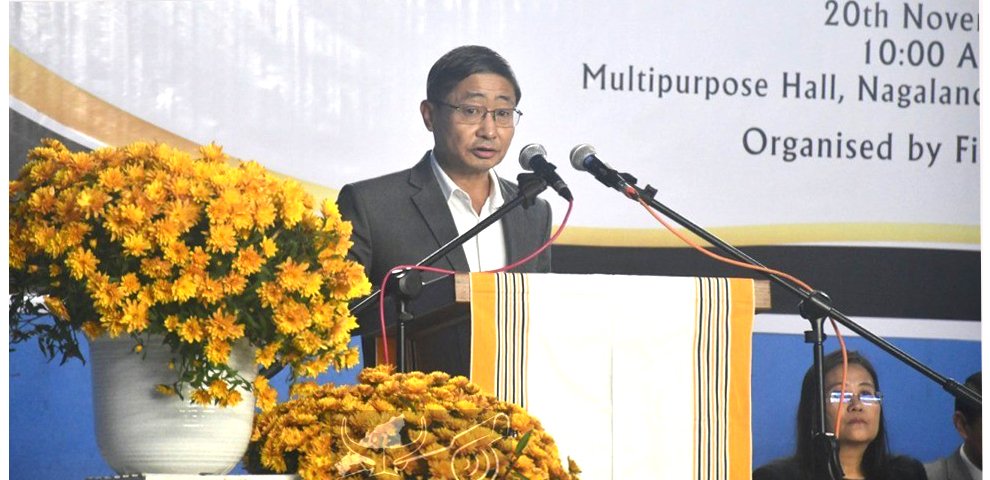
Emphasising the need for effective financial management in a resource-constrained state, Imchen said planning alone would not be enough without proper implementation, coordination and integration among the different wings of the department.
The state’s revenue position illustrates the challenge.
According to Finance Department figures, Nagaland recorded revenue receipts of Rs 16,086.53 crore in 2024–25. Of this, Rs 13,697.82 crore, or 85.15%, came from Central transfers, including the state’s share of Central taxes and grants-in-aid. Revenue generated from the state’s own tax and non-tax sources stood at Rs 2,388.71 crore, accounting for just 14.85% of the total.
The state’s expenditure commitments also leave limited room for other spending. The Comptroller and Auditor General’s State Finances Audit Report for 2024–25 found that committed expenditure and subsidies accounted for 71.50% of Nagaland’s revenue receipts.
Finance Commissioner Kesonyü Yhome said the Finance Department’s role extended beyond regulation to ensuring that public resources were allocated efficiently and translated into tangible developmental outcomes.
He identified limited revenue, infrastructure constraints and over-dependence on Central funds as major fiscal challenges facing Nagaland. He said the department needed to mobilise additional resources while also deploying existing funds strategically to build a strong foundation for a developed state by 2047.
Yhome stressed that improving financial management would require modernising working methods through digital systems and data-driven decision-making. These, he said, could improve forecasting, expenditure planning, cash management and transparency.
He also called for stronger coordination among the department’s different wings, particularly Treasuries, Lotteries and Taxes, and with the Accountant General’s Office, so that challenges could be anticipated and timely policy inputs provided.
Imchen, meanwhile, acknowledged that the state had made progress in integrating financial systems through NIFiMS, TreasuryNET and e-Bill, alongside national platforms such as PFMS and SNA-SPARSH. However, he cautioned that technology and rules alone could not overcome institutional divisions.
Resistance to change and inter-departmental turf and autonomy remained challenges to bringing different offices together, he said, stressing that empathy, clear communication, collaborative problem-solving and adaptability were equally important.
He called on government officials to move beyond traditional mindsets and embrace change, urging senior officers to become catalysts for change.
Referring to Nagaland Vision 2030, Imchen said the focus should move beyond identifying problems and administrative bottlenecks to finding practical solutions and ensuring their implementation.
On the Team Synergy component of the conclave, Yhome called for a collaborative working culture in which senior officers shared their experience, younger staff contributed ideas and institutional knowledge was preserved through stronger systems.
He urged officials to use the conclave as a platform to identify bottlenecks, simplify procedures and strengthen professional camaraderie.
In a reminder of the responsibility attached to their work, Yhome said public resources belonged to the people of Nagaland and that officials were their stewards, entrusted with ensuring their effective use.