
Deputy Chief Minister Y Patton used the Moatsü Festival celebration at Chuchuyimlang Village on Thursday to push for stronger policing, peaceful elections and broader political unity, pairing cultural celebration with pointed messages on governance, public responsibility and the future of Nagaland.
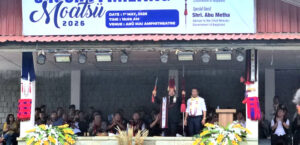
Speaking as the guest of honour, Patton announced that the Chuchuyimlang police outpost could be upgraded into a full-fledged police station, but said the move would be conditional on one key factor, cases must be registered.
He noted that due to customary law practices, many people often do not approach the police even in serious cases, including murder, leading to under-reporting. Stressing the importance of formal legal processes, he urged the public to ensure that cases are registered at the police station.
Patton also appealed to the Ao Naga community to refrain from any form of violence during elections.
Stating that the Aos have historically been “first” in many fields, from the coming of Christianity to achievements in sports and politics, he urged the community not to become “first” in electoral violence.
Referring to the popular perception that Ao, Angami, Lotha and Sumi are among the “forward” tribes, Patton said such communities must lead by setting positive examples.
Responding to criticism surrounding Advisor to the Chief Minister and IDAN Chairman Abu Metha, Patton defended Metha’s expanding public role, saying he has delivered more than some elected representatives, particularly through developmental initiatives benefiting youth.
Despite criticism portraying Metha as merely the Chief Minister’s close aide, Patton said Metha’s work and ability to bring developmental opportunities, especially for young people, justify his role.
Patton also defended Chief Minister Neiphiu Rio against criticism over his age, asserting that Rio remains capable and “still young.” He further said Rio could continue to lead the Nagas for another 10 to 15 years.
Reflecting on his own political journey, Patton remarked that despite spending 43 years in politics, he too still feels young.
On the broader Naga political issue, Patton called for unity among the 33 underground factions, stating that if Nagaland can have an opposition-less government, there is no reason underground groups cannot also unite. He further urged Naga civil society organizations to unite and appealed for unity among the Nagas to work together toward resolving the Naga political issue.
Explaining his presence in Chuchuyimlang, Patton referred to the commonly held notion that Ao, Angami, Lotha and Sumi are “forward” tribes, adding that such communities should lead the rest through positive example such as unity as was seen in the Moatsü Festival.
Advisor to the Chief Minister and IDAN Chairman Abu Metha, who attended as special guest, described Patton as “one of the strongest arms” in running the state and credited him for political stability in Nagaland.
Expressing that he was “very happy and emotional” to return to Ao country, Metha recalled the significant contributions of the Ao Nagas in the Naga political movement, sports, politics and nation-building.
He also stressed the importance of preserving the distinct Naga way of life, calling for the protection, preservation and popularization of Naga culture.
Stating that Nagaland has immense opportunities for wider recognition, Metha said peace and unity across all sections of society remain essential.
“Nagas have to be united to enable the youths to thrive,” he said, warning that division and polarization would only weaken the people.
MLA Nuklutoshi, in his address, thanked dignitaries and invitees for participating in the celebration and highlighted Chuchuyimlang’s distinctive observance of Moatsü through its “Ancha” (Ainja) tradition.
He noted that Chuchuyimlang’s long-standing practice of inviting neighbouring communities reflects a spirit similar to the broader concept later embodied in Nagaland’s Hornbill Festival.
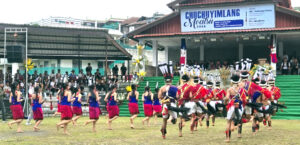
As part of the celebration, Chuchuyimlang observed Moatsü by inviting neighbouring tribes from Longleng and Mon districts. Cultural troupes from Konyak, Phom and Chang communities, along with Ao villages including Unger and Yaongyimsen, performed during the event, reflecting the village’s enduring emphasis on inter-tribal fellowship through culture.