

A scientist from Chungtor working at one of China’s top universities reflects on innovation, research, and why he believes Nagaland’s future may lie in creating opportunities closer to home
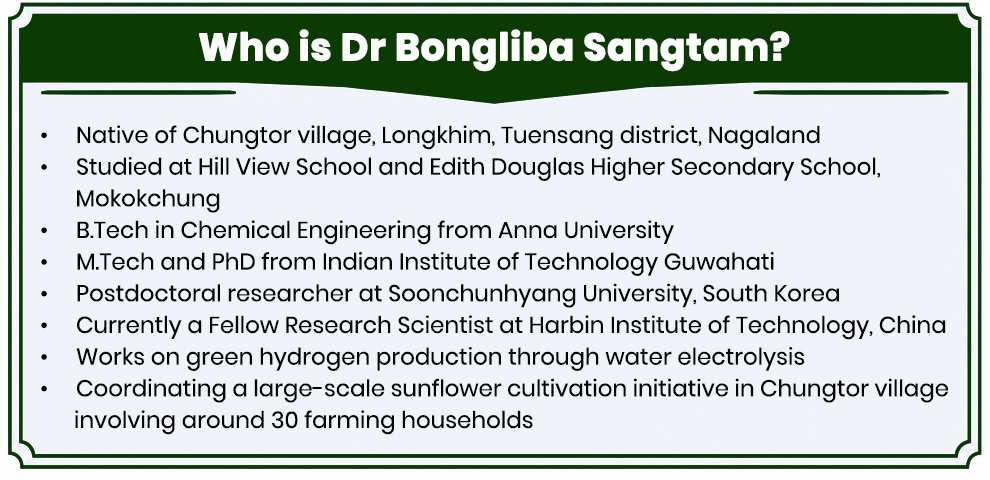
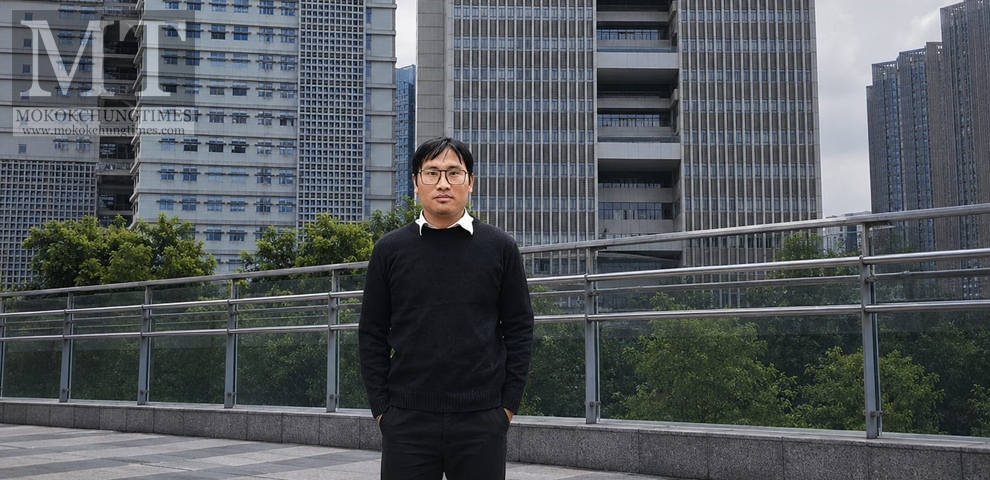
While working on green hydrogen research at one of China’s leading universities, Dr Bongliba Sangtam is thinking about sunflower fields in Eastern Nagaland.
The Chungtor native, currently a Fellow Research Scientist at Harbin Institute of Technology (HIT) Shenzhen, a member of China’s prestigious C9 League, spends his days researching hydrogen production through water electrolysis, a technology many believe could help power the future.
Yet when asked about his own future, Sangtam said, “There is a future in Nagaland. I would love to take up farming in the near future,” and added that he would love to pursue a teaching career in IIT.
His remarks come at a time when Nagaland continues to grapple with questions of youth unemployment, migration and educated professionals seeking opportunities elsewhere.
Having studied and worked in India, South Korea and China, Sangtam believes the state’s lack opportunities that allow talent to thrive. He believes that Nagaland must move beyond a dependence on government jobs and invest more seriously in research and innovation.
Unlike many who make that argument from afar, Sangtam is already attempting one small experiment of his own: helping farmers in Eastern Nagaland test the potential of large-scale sunflower cultivation.
Sangtam completed his schooling at Hill View School and Edith Douglas Higher Secondary School in Mokokchung before pursuing Chemical Engineering at Anna University. He later earned his M Tech and PhD from IIT Guwahati, completed postdoctoral research at Soonchunhyang University in South Korea and eventually joined HIT Shenzhen.
Talking to MT, Sangtam said, the biggest difference between China and India is in how success is defined.
“India counts success in placement while China focuses on innovation,” he said.
In China, he said, “They will evaluate your performance. You are not permanent even if you are in a government institution,” he said. However, in India, he said, “somehow, whether productive or not, once you join, you are there.”
He said, he was also struck by the scale of investment.
“There are lots of funding for research in China. Government invests a lot in education. Many private companies are also willing to invest,” he said.
He further recalled being surprised by the level of collaboration and resource-sharing among some of China’s leading institutions, as well as the close relationship between universities and major scientific and technological projects.
When asked what he thinks Nagaland can learn from China, he said, Nagaland can begin by rethinking how it views education, talent and employment.
“We should be more disciplined and practical,” he said. “For many graduates, a job is our last destination.”
While acknowledging the limited opportunities available within the state, Sangtam said too many young people continue to view government employment as the ultimate measure of success.
As a result, he believes innovation, entrepreneurship and research receive less attention than they deserve.
“We see engineers and educated people ending up in jobs unrelated to their training,” he said.
To change that, he said, “I believe we need research investments. Nagaland government has to bring in some research institutes”.
Asked whether he thinks Nagaland is facing a brain drain problem or just a scenario of missed opportunities, Sangtam offered a more nuanced assessment.
“Educated people in Nagaland get trapped in a system,” he said.
The issue, he suggested, is not simply that people leave, but that many struggle to find an environment where their skills, education and ambitions can be fully utilised.
At the same time, he stressed that responsibility does not rest solely with policymakers.
“Not having enough opportunity is a problem, but it also comes down to political leaders, NGOs, church leaders and public leaders,” he said.
“We need well-learned, educated people to lead because Nagaland is a structured community and good leaders can be the solution.”
Yet despite his criticisms, Sangtam remains optimistic about the state’s future.
That optimism is one reason he became involved in a sunflower cultivation initiative in Chungtor village under Longkhim town in Tuensang district.
The project, coordinated through AgriNova Organic Farmers, currently involves around 30 households, each cultivating at least one acre of sunflower.
The idea emerged during a break following his postdoctoral research, when he attended a conference on oilseed farming and met officials from the Indian Institute of Oilseeds Research (IIOR), Hyderabad.
“We discussed how sunflower had never been tried on a large scale in Nagaland,” he recalled.
The seeds were eventually provided through ICAR Medziphema from IIOR Hyderabad while participating farmers received them free of cost.

“People were actually reluctant at first,” Sangtam said.
Early attempts also produced mixed results.
The first cultivation cycle, conducted in an older field, yielded less-than-expected results. Rather than abandoning the project, the team continued experimenting with different sowing periods and cultivation conditions.
Because shifting cultivation remains common in the state, trials were conducted in both old and newly cultivated fields to compare outcomes.
“We are now experimenting on different fields and months,” he said.
One batch planted in January is currently being harvested, while another planted in March is in full bloom.
The long-term goal is to determine whether multiple harvests can be achieved within a year.
“Our objective is to have harvest three times in a year because economically, farmers lose interest if it is just one season,” he said.
Beyond cultivation, he said, they plans are being considered for an oil extraction.
“We have now proposed an oil expeller,” Sangtam said. “Farmers should be able to earn. They can also roast it, pack it and sell it.”
The initiative has also produced unexpected benefits. Large numbers of honeybees have been observed around the sunflower fields, creating possibilities for future honey production and related activities.
Challenges remain, including damage from rodents and birds as well as questions surrounding long-term marketing and pricing.
But Sangtam believes the project demonstrates an important principle: new opportunities can emerge when people are willing to experiment.
When asked what he thinks the youths should focus on in the next ten years, Sangtam said, “A lot of things will change with AI. It is going to be exciting and worrying at the same time,” he said.
“Many jobs will be replaced,” he added. “Young people have to be flexible to do any work and not just focus on government jobs.”
He also said that AI is likely to make significant breakthroughs in medical science in the near future. According to him, AI can scan millions of research databases in minutes, something impossible for humans to do, thereby accelerating research and contributing to new discoveries.