

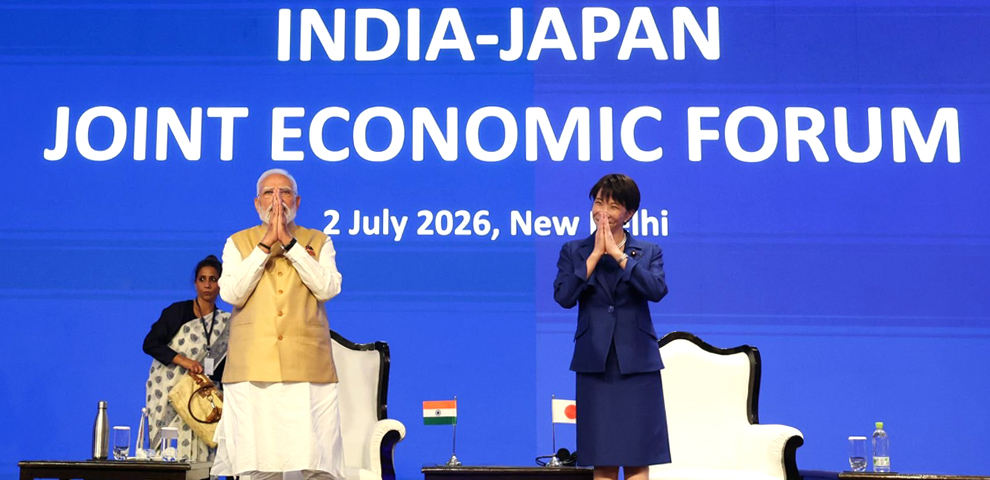
Artificial intelligence, semiconductors and defence cooperation dominated headlines after Prime Minister Narendra Modi and Japanese Prime Minister Sanae Takaichi held the 16th India-Japan Annual Summit in New Delhi on Thursday.
Buried in the Joint Statement, however, was another message.
India and Japan once again reaffirmed the India-Japan Act East Forum, the platform created in 2017 to support development and connectivity in Northeast India. It was only a brief reference in a document covering everything from economic security to energy and emerging technologies. Yet it offered an insight into how Japan continues to view the region.
For much of the past two decades, Japan’s presence in Northeast India has been associated with development projects. Roads, bridges, water supply schemes, disaster management programmes and urban infrastructure, many backed by the Japan International Cooperation Agency (JICA), have become familiar examples of Japanese cooperation in the region.
This week’s summit suggests there is a larger picture.
The Joint Statement places economic security, resilient supply chains, advanced technology and a Free and Open Indo-Pacific at the centre of the India-Japan partnership. Alongside those priorities sits the Act East Forum, a reminder that Northeast India continues to feature in Tokyo’s long-term engagement with India.
That marks a noticeable shift in how the region is viewed.
For years, the Northeast was largely discussed as a remote region that needed better roads and stronger infrastructure. Today, it is also being seen as a link between India and Southeast Asia.
Geography explains why.
The Northeast shares borders with Bangladesh, Bhutan, Myanmar and China. It is India’s only land bridge to Southeast Asia. For New Delhi, that makes the region central to the Act East Policy. For Japan, it fits into its broader vision of a Free and Open Indo-Pacific, where connectivity, reliable supply chains and closer partnerships have become major policy goals.
Japan’s interest in the region did not begin with this summit.
The India-Japan Act East Forum was launched in 2017 to bring together India’s Act East Policy and Japan’s Indo-Pacific vision. Since then, cooperation has expanded into healthcare, disaster resilience, skills development and institutional partnerships, alongside infrastructure projects.
Rather than announcing a new direction, this week’s summit reinforced one that has been taking shape for several years.
There was another detail that received little attention.
Before the summit was finalised, Guwahati had reportedly been considered as the venue before scheduling constraints led to the programme being shifted to New Delhi.
Diplomatic venues are rarely chosen at random.
Had the summit been held in Guwahati, it would have been one of the clearest signals yet that Northeast India has moved closer to the centre of the India-Japan relationship. Even though the venue changed, the continued emphasis on the Northeast in official documents suggests that the thinking behind the proposal has not.
ALSO READ | India, Japan deepen strategic partnership; Northeast figures in connectivity, economic plans
The summit also highlighted how the partnership between India and Japan is changing.
Earlier cooperation focused heavily on infrastructure and development. This time, both countries adopted a Joint Declaration on Economic Security and agreed to deepen cooperation in semiconductors, artificial intelligence, critical minerals, clean energy and resilient supply chains.
Those subjects may appear unrelated to Northeast India.
They are not.
The same documents repeatedly connect economic security with stronger regional connectivity and trusted partnerships across the Indo-Pacific. In that context, the Northeast is no longer seen only as a border region. It is part of a wider network linking India with Southeast Asia.
China was rarely mentioned during the summit, but the language used throughout the Joint Statement points to broader regional concerns. References to resilient supply chains, trusted technology and economic security have become common in Japan’s foreign policy as countries seek to reduce dependence on a single manufacturing base and build more reliable partnerships. None of this translates into immediate projects for Nagaland.
The summit announced no investment specifically for the state. However, Nagaland’s location gives it a place in the larger conversation.
Sharing a border with Myanmar, the state sits along one of the routes that could eventually connect India more closely with Southeast Asia, provided regional conditions improve. Better connectivity could open opportunities for trade, tourism, logistics and agricultural exports, although much will depend on infrastructure, border conditions and political stability.
The summit in New Delhi will be remembered for agreements on technology, defence and economic security. Its quieter message may only become clear over time.
Japan is continuing to invest political attention in Northeast India, not simply because the region needs development, but because of where it is on the map.
The Northeast has long been described as India’s gateway to Southeast Asia, that may prove to be one of the most important outcomes of the summit