

Memorandums of Understanding (MoUs) signed by the Nagaland government across sectors continue to be announced as major steps toward development and investment, but detailed terms of the agreements are generally not made available in the public domain.
From hydrocarbon exploration to skill development, investment facilitation and institutional partnerships, recent MoUs have been showcased through official press releases and public signing ceremonies, often in the presence of senior state and central officials.
These announcements typically highlight broad objectives such as economic growth, job creation and sectoral development.
One of the most significant recent agreements is the June 11, 2026 tripartite MoU between the Government of India, Assam and Nagaland for crude oil and natural gas exploration along the disputed Assam–Nagaland border belt. The agreement was presented as a framework to restart hydrocarbon exploration in the region after decades of uncertainty. However, publicly available information does not include details such as revenue-sharing arrangements, financial commitments, timelines for implementation, or accountability mechanisms.
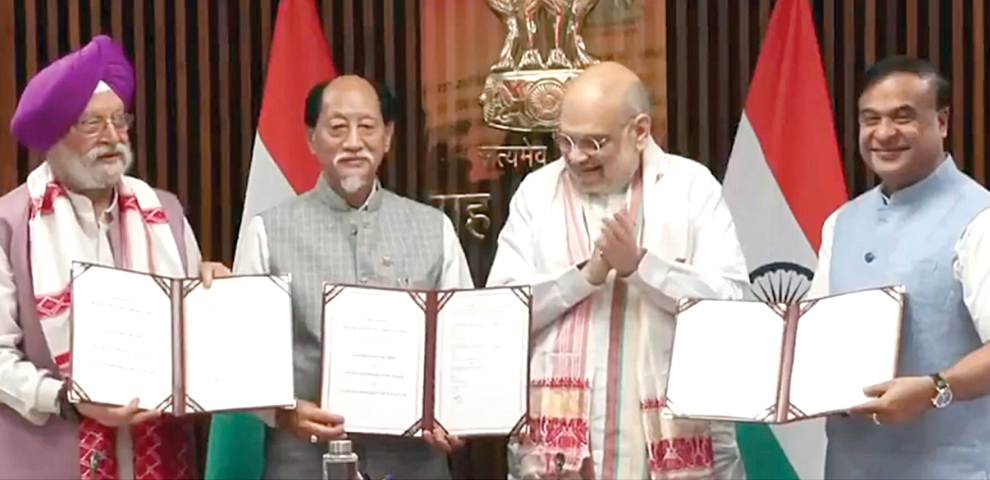
Beyond this, several other MoUs signed by the state government in recent months and years follow a similar communication pattern. These include agreements in areas such as export facilitation with institutions like the Indian Institute of Foreign Trade (IIFT), skill development and entrepreneurship promotion programmes, horticulture value-chain initiatives, renewable energy cooperation and technology-based partnerships.
While each of these agreements is introduced as a step toward strengthening economic and institutional capacity in the state, official communications largely focus on the objectives of cooperation and expected outcomes.
In most cases, details on how the agreements will be implemented, what resources will be committed, and how performance will be measured are not part of the publicly released information.
Most MoU announcements are accompanied by photographs of signing ceremonies and statements from officials involved, but the agreements themselves are not generally accessible for public review.
While MoUs are often framework arrangements intended to express intent rather than legally binding contracts, governance observers note that clarity on key provisions is important where government facilitation, policy alignment or public resources are involved.
The absence of detailed disclosure makes it difficult for citizens and stakeholders to independently assess the scope of these agreements or track whether the intended outcomes are being achieved over time. At present, most information available on MoUs remains confined to official press releases and event-based reporting