
TUN condemns killing of six Nagas in Manipur, demands justice
Nagaland Minister for Power and Parliamentary Affairs KG Kenye on Tuesday warned that Naga society is gradually losing its collective voice and leadership, urging all sections of the people to build consensus on the Naga political issue before divisions deepen further.
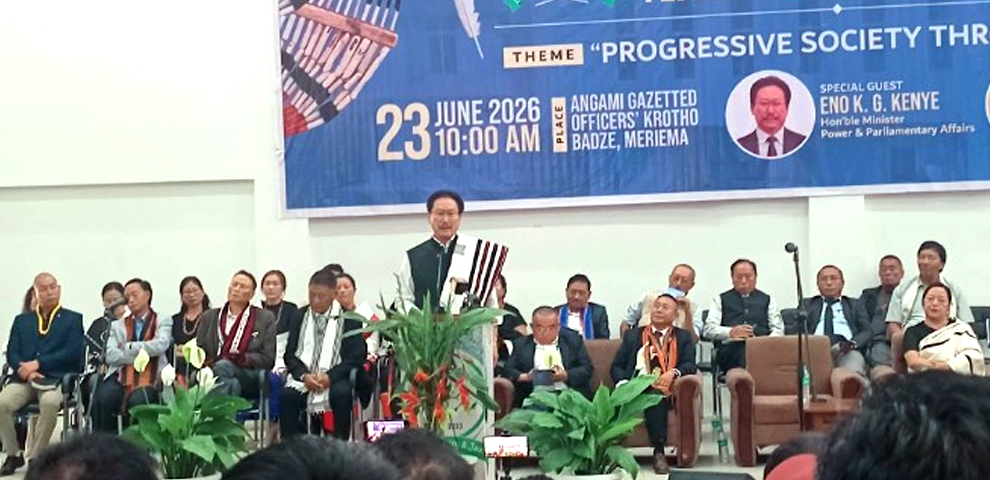
Addressing the first Annual General Session of the Tenyimi Union Nagaland (TUN) under the theme “Progressive Society Through Unity” at Meriema near Kohima, Kenye said the Nagas were passing through a “very sensitive junction” in their history and cautioned that prolonged delays in resolving the political issue were weakening the fabric of society.
Observing that no single organisation today commands the respect or obedience of all Nagas, Kenye said the resulting fragmentation was a matter of concern.
“We are losing grip on our society. There is no centre of control upon our people anymore. Be it Naga political groups, public organisations or even elected governments, we are losing control over what is happening around us,” he said.
Describing the situation as “frightening” and “alarming”, the minister stressed the need for consensus and warned that a society without a common identity, leadership or guiding institution risked an uncertain future.
Kenye said the Tenyimi Union was distinct from organisations formed on territorial considerations, as it was founded on shared ancestry, history and customary practices of the Angami, Chakhesang, Pochury, Rengma and Zeliang tribes.
“Our group is not born out of geography or territorial blocks. Ours is of ethnicity, ancestry and a shared common history,” he said.
According to the minister, the union was established to address issues affecting the five Tenyimi tribes within Nagaland’s administrative boundaries while maintaining cordial relations with other Naga communities.
He also urged the organisation’s leadership to exercise restraint and sensitivity in its activities, cautioning against actions that could create misunderstandings among other Naga tribes.
“Let us not overshadow or try to become too dominant over our other Naga communities. Let good sense, logic and balanced leadership guide our decisions,” he said.
During the session, the Tenyimi Union Nagaland adopted a series of resolutions, including a strong condemnation of the killing of six Nagas in Kangpokpi district of Manipur earlier this month.
The union described the incident as the “brutal murder” of six innocent Nagas and alleged that the killings were carried out by Kuki militants. It termed the incident “unimaginable, ruthless and inhuman” and demanded the immediate identification, arrest and prosecution of those responsible.
TUN urged the governments of Manipur and India, along with law enforcement agencies, to ensure justice without delay and called for the strictest punishment permissible under the law.
The union also expressed concern over the increasing incidence of crimes against women and children, stating that no society can progress if the dignity, safety and security of women and children remain under threat. It called for swift justice in cases involving sexual abuse and said delays in the justice delivery system often encourage offenders.
On Naga unity, TUN welcomed the initiatives of the Nagaland Tribal Hohos Coordination Committee (NTHCC), stating that efforts to strengthen unity and brotherhood among Nagas would help safeguard the rights, interests and aspirations of the Naga people.
The union further resolved to support the promotion and development of the Tenyidie language through the efforts of Ura Academy. It acknowledged the academy’s contribution in advancing Tenyidie to postgraduate and doctoral levels and pledged to strengthen the language as a common medium of communication among Tenyimi communities and the wider Naga society.
Also addressing the gathering, Minister for Women Resource Development and Horticulture Salhoutuonuo Kruse called on the Tenyimi community to strengthen unity, brotherhood and shared cultural values. She encouraged the younger generation to uphold the principles of character, compassion and service while collaborating with other tribal and civil society organisations for the progress of the Naga people.
The resolutions were signed by TUN president Kekhwengulo Lea and members of the resolution committee.
(With inputs from PTI)