
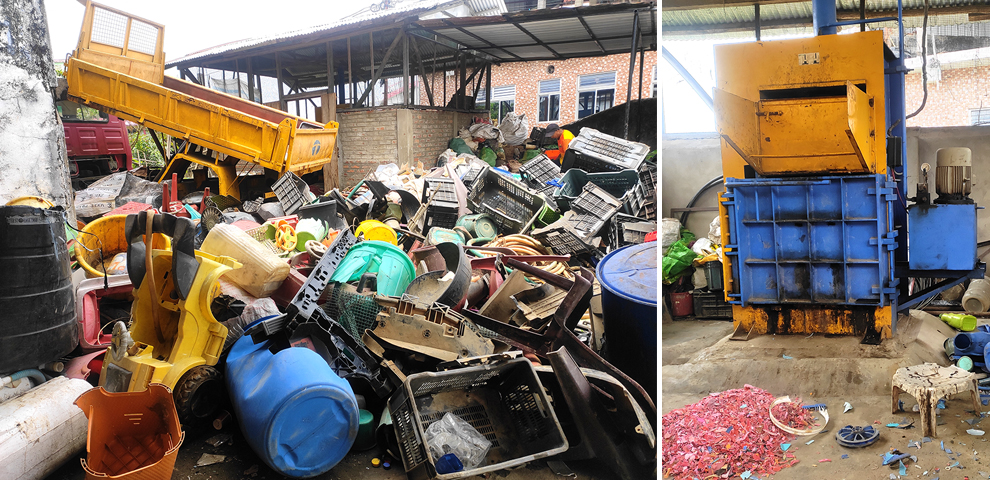
The facility, set up under the Swachh Bharat Mission, became operational in 2021 after construction began in 2019. It is equipped with a bailing machine, shredding unit and digital weighing system, and handles segregation and processing of recyclable waste collected from the town.
According to Sanitation Inspector Kilepchiba of the MMC, the MRF does not run continuously throughout the year and typically functions only for a few weeks at a time depending on the volume of collected waste.
“The facility is not meant for profit. It is meant to manage waste and keep the town clean,” he said.
The operation currently involves three staff members, who are not permanent employees, as the volume of waste generated in Mokokchung is insufficient to sustain full-time operations.
The MMC has implemented a collection system that includes household-level segregation, ward-based collection drives, and cleanliness campaigns in schools and public spaces. The council also provides an incentive of Rs. 3,000 per fully loaded pickup truck of plastic waste delivered to the facility.
An initial attempt to collaborate with local scrap dealers for door-to-door collection was not successful, following which the present system of community-driven segregation was strengthened, officials said.
At the MRF, collected waste is segregated into soft and hard plastics before being processed using the facility’s machinery. Soft plastics include carry bags and wrappers, while hard plastics consist of rigid items such as containers and buckets.
The processed material is then bundled and sold to recycling units in Guwahati, Assam, at reduced rates. Multi-layered plastic waste, including packets and laminated packaging, is transported to cement factories through arrangements facilitated by the Nagaland State Government. The transport is carried out via Nagaland State Transport (NST) through the Dimapur Municipal Council (DMC) without additional cost for the MMC.
In addition to plastic, the facility also handles glass, paper and e-waste collected from the town.
However, officials said the scale of operations remains limited. The MRF does not generate enough recyclable material to function continuously, raising questions on the feasibility of expansion or establishment of a full-scale recycling plant in the town.
Water availability is also a constraint. Industrial recycling processes typically require large volumes of water for washing and processing plastics – estimated at over 3,000 litres per tonne – making large-scale expansion difficult in a town where many households already depend on purchased water supplies.
Despite these limitations, officials expressed optimism that continued community participation and proper waste segregation practices will strengthen Mokokchung’s waste management system in the long term.
“People’s cooperation is key. Waste management cannot work without community responsibility,” Kilepchiba added.
(This article was reported by Sangro, an intern reporter, and edited by the editorial team for clarity, structure, and publication.)