
All tribal languages in Nagaland will be taught up to Class 9 from the current academic year, Additional Director of School Education Deenabandhu Panda announced during the General Session-cum-General Body Meeting of the Association of Nagaland Literature Boards (ANLB) held at Platinum Hall, NBCC Complex, Bayavu Hill, Kohima, on Friday.
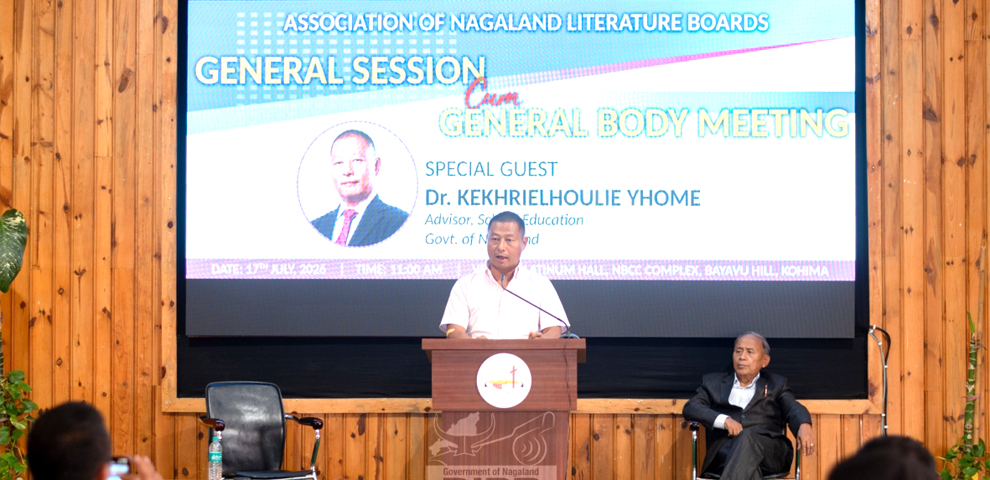
Addressing the gathering, Panda said the initiative aligns with the National Education Policy (NEP) and aims to preserve the state’s rich linguistic and cultural diversity. He noted that while only Tenyidie was widely taught in schools in the past, all tribal languages have now been incorporated into the education system.
He acknowledged the efforts of literature boards, the School Education Department and the public in promoting indigenous languages, and called for continued collaboration to strengthen their development. He also encouraged greater use of local languages within communities and reaffirmed the department’s commitment to supporting literature boards in promoting indigenous languages.
Advisor for School Education Dr Kekhrielhoulie Yhome, who attended the program as the special guest, stressed the importance of preserving indigenous languages as a means of safeguarding the cultural identity of minority communities. He advocated teaching mother tongues from the foundational stage and highlighted the need for developing and enriching indigenous vocabularies to keep pace with changing times.
Dr Yhome also underscored the role of Bible translations and the use of indigenous languages in religious practices in preserving many Naga languages. He called for collaboration among linguists and scholars to ensure accurate translations and emphasized the need for translating literature, developing textbooks, encouraging research and recognising literary contributions.
Highlighting Nagaland’s multilingual environment as a strength, he said children in the state often grow up learning their mother tongue, English, Nagamese and other tribal languages, which enhances cognitive abilities and strengthens cultural identity. He added that the State Curriculum Framework seeks to promote tribal languages through sustained institutional support and community participation.
Earlier, ANLB president B Tingshem Konyak welcomed the gathering and highlighted milestones in language promotion, including the Nagaland Legislative Assembly’s 2019 resolution supporting 13 indigenous languages, the state government’s financial assistance to literature boards and the introduction of locally developed textbooks for Class 9 from the current academic year.
Vice President of Ura Academy Daso Paphino also addressed the meeting, tracing the development of the Tenyidie language and highlighting the academy’s contribution to language promotion through education, publications and research.
The program concluded with a business session during which members discussed the adoption of the ANLB Constitution, establishment of a language institute or academy, appointment of language teachers, strengthening of the ANLB fund and other measures aimed at advancing language preservation and literary development in the state.