
Organisation says birds were rescued and raises five questions over enforcement
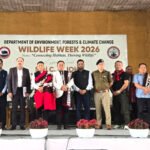
The Centre Chakhesang Youth Organization (CCYO) has strongly condemned what it described as the “misleading, concocted and false statement” made by PCCF & HoFF, Nagaland, Vedpal, on October 6 at Mokokchung during Wildlife Week regarding the detention of Vezhoto Hesuh.
According to the CCYO, Vedpal had stated that Vezhoto Hesuh “was not detained for taking photographs, but for removing birds from their natural habitat and rearing them.”
The organisation termed the statement “a deliberate attempt to create a false narrative and justify the high-handed detention” of Vezhoto Hesuh, while alleging that it disregarded and insulted “the customary and traditional practices of the Naga people, which are constitutionally protected under Article 371A of the Constitution of India.”
On the owl involved in the matter, the CCYO stated that “the owl in question was not captured from the jungle” but “was rescued by a minor boy from Porba Village, who found it near a footpath leading to the fields on a rainy day.”
READ | Wildlife Week 2026 | Forest Department clarifies wildlife law amid Phek case controversy
“The bird was completely wet, shivering and apparently helpless. The boy picked it up, dried it and cared for it, thereby saving its life,” the organisation said, adding that had it not been rescued at that point, “it could have died from exposure to the rain and cold.”
The CCYO further claimed that “the owl was never kept in a cage” and said that, as visible in the circulated photograph, “the bird was sitting freely on the shoulder of Vezhoto Hesuh.”
It stated that the owl “had become so accustomed to human care that it would fly into the jungle and return on its own,” eventually flying away to its natural habitat.
“Where is the crime in rescuing and saving a helpless bird? And where is the cage?” the organisation asked.
Regarding the Great Barbet, the CCYO said it “was found injured by a minor boy while he was returning from the field” and that “the bird was unable to fly.”
“The boy therefore took it home and cared for it for several years with love and affection. Had the injured bird been left unattended at that time, it could have died,” it stated.
The organisation said the Great Barbet “is not merely a bird” for its community, but “has traditionally been regarded as a natural or traditional clock and companion of the village, with its distinctive call serving as a familiar indication of time and the changing hours of the day.”
“The caring and rearing of rescued or injured birds and animals have been part of our customary practices and traditional relationship with nature for generations,” the CCYO stated.
It advised Vedpal “not to make statements that insult, ridicule or disregard the customs and traditions of the Naga people while relying solely upon laws and administrative practices that the people believe fail to adequately recognise their customary relationship with nature.”
The CCYO also questioned the Forest Department’s handling of the Great Barbet. It stated that the bird “was reportedly in a healthy condition when it was seized by the officials” but, when subsequently returned, “was reportedly so weak that it could not even fly properly.”
“This raises a serious question: If the Forest Department, as the agency responsible for wildlife protection, could not maintain the health of the bird for a few days, how can it lecture villagers about caring for rescued wildlife?” the organisation asked.
ALSO READ | A Great Barbet, a wildlife case and Article 371A: CCYO marches in Pfutsero over Forest Department action
According to the CCYO, villagers “once again nursed the bird, fed it and helped restore its strength before it returned to the jungle.” It added that “a video of the Great Barbet feeding on wild berries in the jungle was also shared with the Forest Department.”
The organisation also raised a series of questions for the PCCF & HoFF.
“You cannot preach one thing and practise another,” the CCYO stated, questioning where animals and birds kept in the Nagaland Zoological Park come from if the Department’s position is that people cannot rear birds or remove them from their natural habitat.
It further asked: “Why are animals kept in captivity in zoos for public viewing?” The organisation questioned why a member of the public who “rescues an injured or helpless bird and cares for it with affection” should be treated as an offender if the Department itself keeps animals in captivity.
On Vezhoto Hesuh’s detention, the CCYO asked: “Why was Vezhoto Hesuh detained when he did not collect or remove the birds from their habitat?”
“The birds in question were rescued and cared for by villagers of Porba. What was the specific basis for detaining Vezhoto Hesuh in connection with those birds?” it asked.
The organisation also questioned whether Vezhoto’s alleged confession was obtained “under pressure or coercion,” claiming that it understood that officials had “allegedly pressured Vezhoto into stating that he had reared the bird.”
“However, thousands of villagers know how and where the birds were rescued and cared for. Is obtaining a confession under pressure the Department’s method of enforcing wildlife protection?” the CCYO asked.
It further questioned whether the same standards would be applied to “influential persons, VIPs and politicians in Nagaland who are alleged to keep wild animals and birds in private farmhouses, estates and bungalows.”
“Or is this so-called law enforcement intended only for ordinary people like Vezhoto Hesuh while the powerful and well-connected remain untouched?” the organisation asked.
The CCYO also questioned whether the Wildlife Week programme at Mokokchung was organised “to promote genuine awareness and conservation or to provide a platform for repeating a one-sided and manufactured narrative to justify the detention of Vezhoto Hesuh.”
“Instead of addressing the serious questions surrounding his detention, the Department appears to have used the occasion to repeat allegations against him,” it stated.
“Wildlife conservation cannot be built upon intimidation, selective enforcement, disregard for local communities or denigration of customary practices,” the CCYO said.
ALSO READ | CCYO begins non-cooperation movement against Forest Department
The organisation called upon the PCCF & HoFF “to show due respect and regard for the customary practices, traditions and rights of the Naga people,” stating that “Nagas are not without their own traditions, institutions and relationship with their land, forests and wildlife.”
The CCYO demanded “an immediate and clear clarification from the PCCF & HoFF on each of the questions raised above” and called upon the Department “to refrain from making misleading statements concerning Vezhoto Hesuh and the people of Porba.”