

Nagaland on Thursday carried out the 8th edition of the Nagaland Emergency Preparedness Exercise (NEPEx) 2026 across districts, simulating a devastating 7.7 magnitude earthquake and extreme weather scenario in what became one of the state’s largest coordinated disaster preparedness exercises.
Organised by the Nagaland State Disaster Management Authority (NSDMA) in collaboration with district administrations, DDMA units, and the National Disaster Management Authority under the Ministry of Home Affairs, the statewide mock drill tested emergency communication systems, Incident Response Systems (IRS), search and rescue capabilities, evacuation protocols, medical response, and blackout preparedness.
Statewide simulation across Nagaland
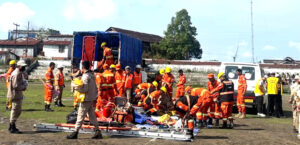
Beginning at 8:00 AM with emergency sirens, districts activated District Emergency Operation Centres (DEOC), Incident Command Posts, and staging areas while SDRF, Fire & Emergency Services, Home Guards, police, health teams, civil defence, and community volunteers responded to simulated disasters ranging from collapsed schools and hospitals to landslides, fires, fuel station incidents, and mass casualty events.
Kohima
In Kohima, DDMA coordinated operations from Indira Gandhi Stadium and Ruzhükhrie Ground, with mock incident sites at Sanuorü Bridge, NH-2, TIR Station, KL Market, Mewi Higher Secondary School, and Fisheries Directorate. Kohima also conducted “Operation Night Guard,” an air raid and blackout exercise involving sirens, a 15-minute blackout, and public compliance. DC B. Henok Buchem noted communication gaps and called for upgraded radio handsets.
Dimapur
Dimapur’s drill simulated major structural collapses, fires, and casualties at Purana Bazar, Hollotoli School, Westside Store, IOCL Kevijau, and PHC Purana Bazar, alongside “Operation Night Guard.” Relief camps, temporary hospitals, and restoration of power, water, and communication systems were tested. DC Dr. Tinojongshi Chang said the exercise was aimed at building awareness in a state located in Seismic Zone V.
Mokokchung
Mokokchung activated its IRS under DC Ajit Kumar Verma, IAS, with incident zones at Government High School Dilong, IMDH Building, DC Office, and Mokokchung Village landslide sites. Wireless blackout coordination, live-streamed rescue at Dilong school, and district-wide response showcased institutional preparedness.
Peren and Jalukie
Peren district and Jalukie sub-division simulated multi-hazard scenarios including school collapses, gas station fires, landslides, bridge failures, and hospital emergencies. Officials stressed that community sensitization is crucial, noting that local communities are often first responders before formal systems fully mobilize.
Mon, Tuensang, Noklak, Kiphire, Shamator
Eastern Nagaland districts simulated severe humanitarian crises involving landslides, mass casualties, missing persons, fuel station fires, and school rescues. Mon’s scenario combined earthquake and extreme weather, while Tuensang projected over 11,000 damaged houses and 114 deaths in its model.
Niuland, Chümoukedima, Wokha, Zunheboto, Longleng, Meluri, Phek
These districts tested earthquake response through scenarios involving damaged schools, district hospitals, market collapses, road blockades, landslides, and medical shortages. Chümoukedima observers stressed resource mapping and dedicated communication channels, while Wokha integrated Doyang Dam and “Operation Night Guard.”
Key focus: Preparedness, coordination, and public awareness
Across districts, officials consistently highlighted:
- Strengthening inter-departmental coordination
- Identifying communication and logistical gaps
- Testing wireless systems during blackout scenarios
- Improving rescue and medical response
- Building community-level preparedness
Why it matters
Nagaland falls under Seismic Zone V, making it highly vulnerable to major earthquakes. Officials said NEPEx is designed not only to assess institutional readiness but also to ensure communities understand response mechanisms before an actual disaster.