

The financial sustainability of regional newspapers has emerged as a growing concern for independent journalism in Nagaland, with rising production costs, declining print circulation and dependence on government advertisements placing pressure on editorial independence.
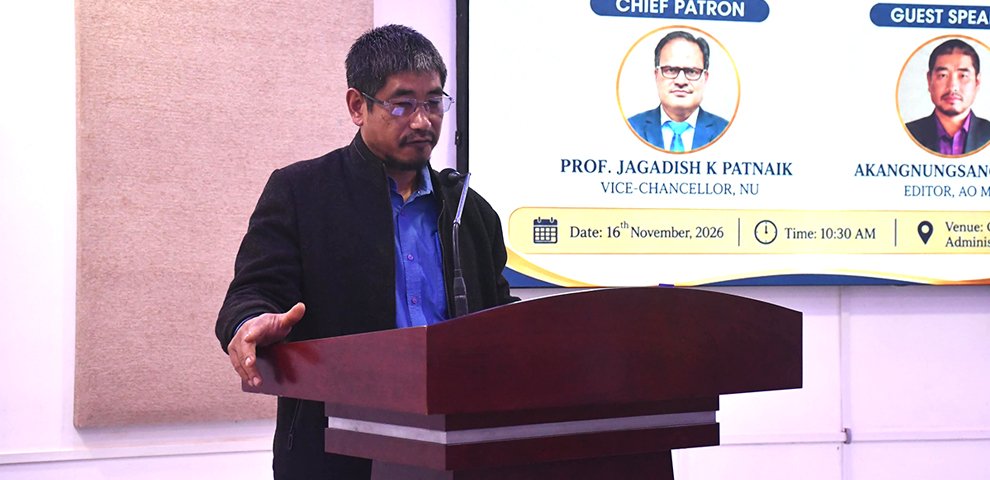
Editor of Ao vernacular newspaper, Ao Milen, Akangnungsang Jamir, highlighted these challenges while addressing the National Press Day observance by Department of Journalism and Mass Communication at Nagaland University, Lumami, on Monday, cautioning that the independence of a newspaper was influenced not only by the professional integrity of its journalists but also by the economic conditions under which it operated.
Jamir said that even small regional newspapers were confronting rising printing and production costs, shifting reading habits and severe financial strain. He pointed out that growing online readership did not automatically translate into revenue, leaving newspapers with the difficult task of sustaining operations amid changes in the media landscape.
In smaller media markets such as Nagaland, he said, government advertising could be an important revenue source for regional and vernacular newspapers. However, he cautioned that where dependence became substantial, financial pressures could complicate editorial independence.
“Independence is not merely a matter of personal courage. It also depends on the economic conditions under which news organisations operate,” he said, stressing the importance of building sustainable and diversified revenue models to protect independent journalism.
The financial challenges come amid a broader transformation in how news is produced and consumed. Jamir observed that the shift towards digital platforms had changed the traditional newspaper business, with publishers increasingly required to maintain an online presence while continuing to meet the costs of print production.
He also raised concerns over the growing use of artificial intelligence and automated news summaries, which could further affect the financial viability of news organisations. As audiences increasingly rely on AI-generated search summaries and aggregators for information, fewer readers may visit original news websites, reducing the traffic and advertising revenue needed to fund original reporting.
While acknowledging the opportunities offered by technology, Jamir stressed that AI could not replace the fundamental work of journalism, including visiting remote villages, interviewing witnesses and verifying official records.
His observations also brought attention to the continuing importance of local and vernacular newspapers, which often cover issues overlooked by larger media organisations, including damaged rural roads, shortages of teachers in government schools and the lack of essential supplies in primary health centres.
In Nagaland, he said, vernacular newspapers served not only as sources of information but also as platforms connecting communities, documenting everyday struggles and preserving indigenous languages and cultural memory.
The concerns over financial sustainability and editorial independence also featured in the National Press Day observance organised by the Dimapur Press Club, where journalist and Trustee of The Reporters Collective Trust, Nitin Sethi, spoke about the challenges faced by media professionals in the Northeast.
Sethi said journalists often worked in societies where relationships between communities, the State and the larger nation were still evolving. He noted that journalists faced pressure from community groups and influential individuals not to report on certain issues or personalities on the grounds of community identity.
He stressed that journalists must continue to question those in authority and make them accountable to vulnerable sections of society, despite the difficulties involved.
The discussions highlighted a challenge confronting regional journalism: maintaining editorial independence while operating in a financially constrained media environment where the sustainability of news organisations remains uncertain.