

Unsafe and contaminated food continues to pose a significant threat to public health, with food-borne illnesses placing a burden on families, healthcare systems and businesses, Nagaland Health & Family Welfare Secretary S Tainiu said on the occasion of World Food Safety Day 2026.
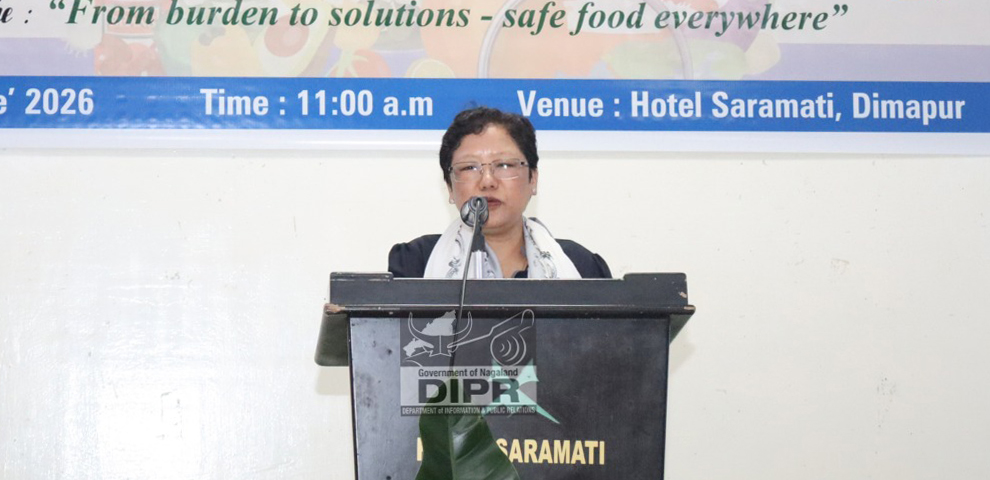
Speaking at the state-level observance of the 8th World Food Safety Day at Hotel Saramati, Dimapur, Tainiu said food safety should be viewed not only as a health issue but also as a social and economic concern requiring collective action from government agencies, food businesses and consumers.
She noted that millions of people worldwide fall ill every year due to contaminated food, with children under five among the most vulnerable.
Unsafe food, she said, can result in food-borne diseases, hospitalisation and even death.
The program, organised by the Food Safety Wing under the Department of Health & Family Welfare in collaboration with the Food Safety and Standards Authority of India (FSSAI) and Eat Right India, was held under the theme “From Burden to Solutions – Safe Food Everywhere.”
Calling on food business operators and hospitality establishments to strengthen food safety practices, Tainiu stressed the need for hygiene and sanitation in kitchens and dining areas, regular training of food handlers, safe sourcing of food products and proper storage practices.
She also highlighted growing concerns surrounding food allergens and urged food establishments to clearly identify allergen-containing foods and train staff to respond appropriately to customers with dietary restrictions and allergy-related concerns.
Tainiu further called for emergency response mechanisms to address food complaints, suspected food poisoning incidents and product recalls in a timely manner.
Speaking on the theme, State Programme Officer (Food Safety) Dr John Kemp said food safety is a shared responsibility involving everyone across the food chain, from producers and transporters to retailers, food inspectors, cooks and consumers.
He stressed that scientific evidence and data are essential for identifying food safety risks and developing effective measures to reduce food-borne diseases. According to him, strengthening food safety surveillance systems, improving traceability within food supply chains and enhancing public awareness are critical steps towards ensuring safer food.
Representing the hospitality sector, Nagaland Hotel & Restaurant Association Finance Secretary Vikie Nagi described food safety as the “invisible backbone” of the tourism and hospitality industry. He said maintaining food safety standards is essential for protecting public health and sustaining consumer confidence.
The program also included a practical training session for hoteliers and stakeholders on food adulteration, food contamination and hygienic food-handling practices. Food technicians demonstrated proper hand hygiene techniques and stressed that safe food begins with clean hands.
Officials said ensuring safe food requires cooperation among regulators, food businesses and consumers alike, as food safety remains a key component of public health and economic well-being.