
The Political Science Association (PSA) of Fazl Ali College, Mokokchung, organised its introductory programme for freshers-cum-3rd PSA Debate on the theme, “Article 371A: Does it really protect the interests of Nagaland?” at the college auditorium on 3 October.
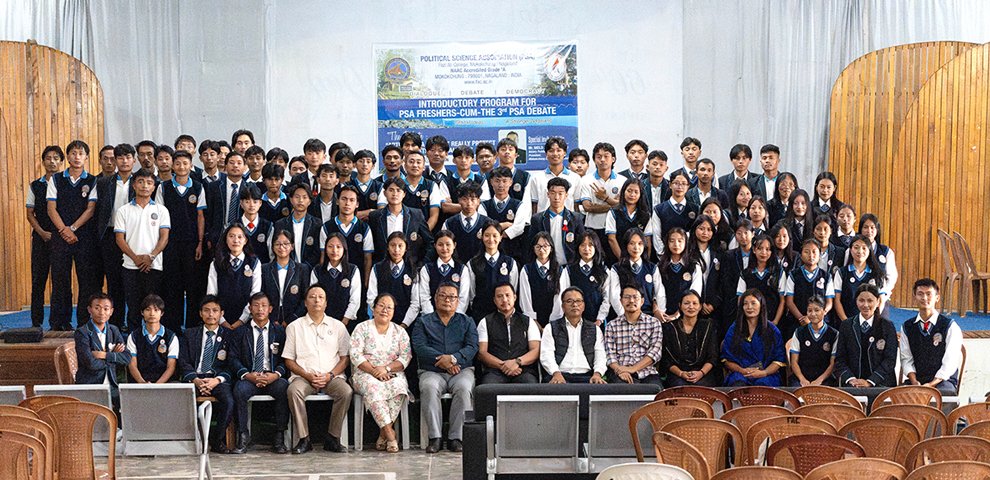
Five speakers represented each of the For and Against the Motion teams, with the debaters deliberating on the constitutional provision and its significance for Nagaland. The For the Motion team was led by Bendangienla, while Chichanrhomo led the Against the Motion team. The discussion provided participants an opportunity to present their respective arguments on the scope and implications of Article 371A.
Molo Jamir, Notary Public and Mediator and President of the Mokokchung District Bar Association, attended as the special invitee and critic. In his address, Molo Jamir spoke about what Article 371A actually protects, including the religious or social practices of the Nagas, Naga customary laws and procedures, administration of civil and criminal justice involving decisions according to Naga customary law, and ownership and transfer of land and its resources.
He further questioned whether Article 371A really protects Nagaland, stating that while the provision does provide protection, its scope is narrower in that it does not confer a constitutional veto on the State over certain issues. At the same time, he noted that the provision is more significant than is sometimes assumed, as it creates a constitutional safeguard against the automatic application of Parliamentary laws in four fundamental areas.
To help the students better understand the provision, he also drew a comparative trajectory between Nagaland and Tripura, highlighting the differing constitutional arrangements and their implications for the two States.
The debate was moderated by Yongkai Phom. Dr E. Benrithung Patton, Associate Professor of Political Science, delivered the introductory note, while the closing remarks were delivered by Dr Lipokrenla Jamir, Associate Professor and Head of the Department of Political Science.
The PSA stated that the debate was aimed at providing students with a platform to engage with political and constitutional issues while developing critical-thinking and public-speaking skills. The discussion on Article 371A also allowed students to examine the issue from different perspectives.