
The walls of a classroom at Government High School Jalukie B in Peren are telling a story. Not through textbooks or blackboards, but through a colourful mural based on a traditional Zeliang folktale of an orphan boy who overcomes hardship and transforms into a hornbill.
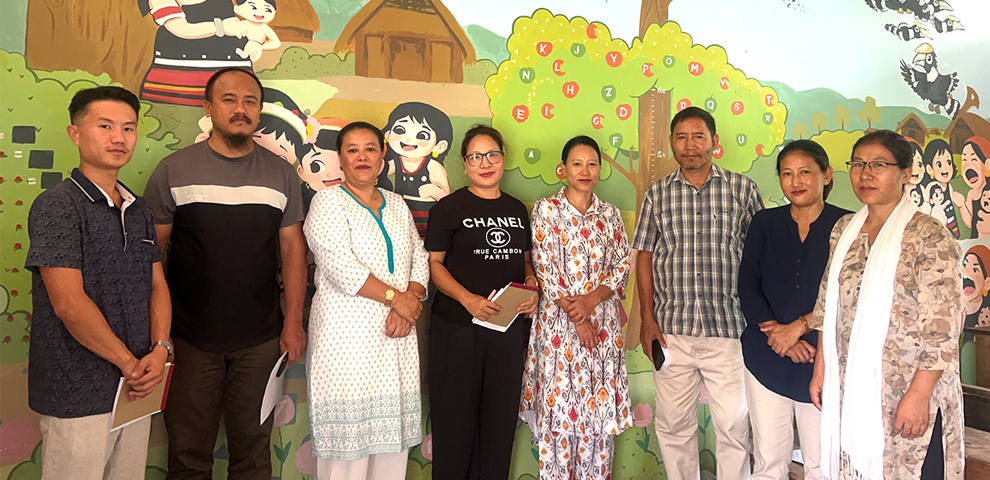
For primary teachers gathered there on June 12, the artwork offered a glimpse into a different way of teaching. Interwoven into the folktale are alphabets, multiplication tables, geometric shapes, measurement scales, trees, hills and cultural symbols. The classroom itself has become a learning resource.
The initiative is part of Building as Learning Aid (BaLA), a programme under the District Empowerment Program (DEP) that transforms school infrastructure into teaching tools. Instead of introducing new materials, BaLA uses walls, floors and corridors to support learning across subjects for children in primary classes.
“Children learn best when they can connect learning to their own experiences and surroundings,” said Ashish Shrivastava, Co-founder of Shiksharth, who facilitated the training. “BaLA helps schools transform ordinary spaces into vibrant learning environments that encourage exploration, creativity, and critical thinking.”
The approach has already taken root in Mon district, where teachers used the Konyak folktale of Halem, the Flower Goddess, to teach literacy, environmental studies and cultural heritage. In Peren, the hornbill story now serves a similar purpose, helping teachers explain everything from fractions to local ecology.
Teachers say the murals make lessons more engaging because children see their own culture reflected in the classroom. More than decoration, these painted walls are becoming silent teachers, turning everyday school spaces into places where stories and learning meet.