
FGN leader says Naga independence was declared a day before India became independent on August 15
FGN leader Takuyaba on Sunday placed the events of 1947 at the centre of the Naga political position, drawing a parallel with Pakistan’s independence declaration to argue that Nagas had declared their own independence before India became independent.
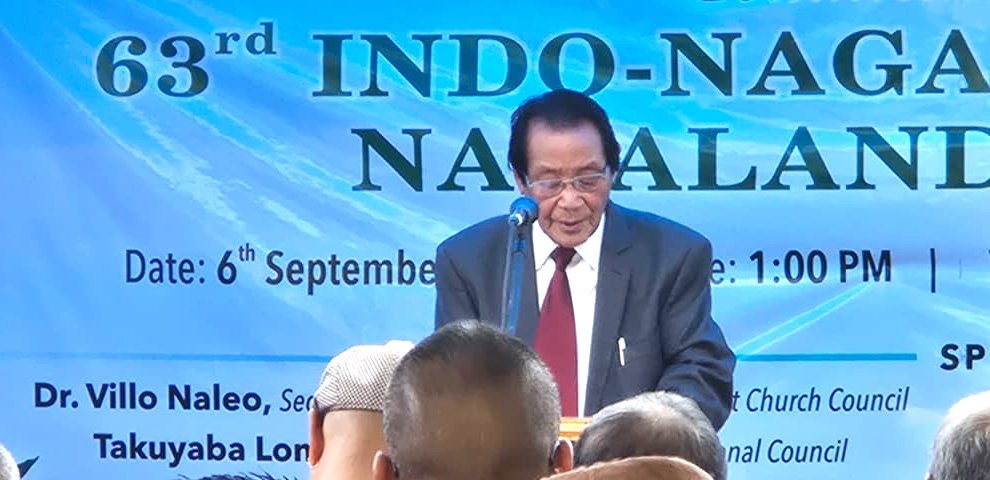
Speaking at the 63rd Indo-Naga Ceasefire Day programme at the Peace Talk Camp, Khensa, Takuyaba referred to Resolution No 2 adopted by the Indian Constituent Assembly on January 22, 1947. He said the resolution proposed that the territories of British India, the Indian States and such other territories as were willing to join would constitute “a Union of them all.”
According to Takuyaba, Nagas and Pakistanis refused to join the proposed Indian Union and both declared independence on August 14, 1947, while India declared independence on August 15.
“Therefore, that Nagas were not with or under India even for a single second is an axiom,” he said.
Takuyaba further cited the Naga Voluntary Plebiscite conducted on March 16, 1951, saying 99.9 per cent of voters supported independence. He described the plebiscite as a confirmation of the August 14, 1947 declaration.
He also traced the Naga political position through developments in the eastern territories, referring to the refusal of the Free Nagas to sign the Panglong Agreement and the subsequent formation of the Hongking Government. He said the Hongking Government and the Naga National Council later formed the Federal Government of Nagaland in 1956.
Turning to the armed conflict, Takuyaba alleged that the Indian Army entered Nagaland from 1955 and that a series of laws were imposed during the period, including the Assam Disturbed Area Act, 1953, the Armed Forces (Special Powers) Act, 1958, and the Nagaland Security Regulation Act, 1962.
He alleged that the period was marked by widespread human rights abuses, including killings, burning of houses, torture and sexual violence.
Against this backdrop, he described the September 6, 1964 ceasefire between the Government of India and the Federal Government of Nagaland as the outcome of the peace initiative led by the Nagaland Baptist Church Council’s Peace Mission.
Takuyaba maintained that the 1964 Ceasefire Agreement remains “the only valid agreement” made by competent authorities and said the FGN and NNC continue to uphold it.
He alleged that the Government of India unilaterally abrogated the ceasefire on August 31, 1972, while maintaining that the Naga side continued to recognise the agreement.
Takuyaba also invoked Article 3 of the United Nations Declaration on the Rights of Indigenous Peoples, adopted in 2007, which recognises the right of indigenous peoples to self-determination, including the freedom to determine their political status and pursue their economic, social and cultural development.
He said the Naga position rests on what he described as the right to sovereignty, the August 14, 1947 declaration of independence, the 1951 plebiscite and the principle of self-determination.
ALSO READ | FGN reaffirms 1964 ceasefire position, calls for Naga unity
Takuyaba also appealed to churches under the NBCC umbrella to observe September 6 as Peace/Ceasefire Day and ensure that the historical background of the day is properly communicated.
For the Nagaland Baptist Church Council, however, the meaning of the ceasefire goes beyond simply ending violence.
Dr Villo Naleo, Secretary of Social Concern, NBCC, said the Church’s responsibility should extend beyond calling for an end to violence to actively building reconciliation.
“Ceasefire must lead us to a just peace,” Naleo said, adding that the Naga political question could not be resolved simply through administration, military strength, economic packages or the passage of time.
He said it required political will, dialogue, truth, justice and reconciliation.
Naleo also turned the idea of peace inward, saying political groups and communities could demand peace while continuing to harbour hatred or deny justice to others.
He said an individual could demand political peace while carrying hatred in his or her heart, while a church could preach reconciliation while remaining divided internally. Likewise, a community could demand justice while denying justice to its neighbour.
For Naleo, therefore, Christian peace had to begin “within us”, with individuals, churches and communities developing a shared vision of peace.