

Kezha Angami says lasting peace requires political will, truthfulness and integrity
The Federal Government of Nagaland (FGN) on Sunday reaffirmed its position on the 1964 Indo-Naga Ceasefire, maintaining that military aggression cannot provide a solution to the Naga political issue and calling for a lasting settlement through political engagement.
Speaking at the commemoration of the 63rd Indo-Naga Ceasefire Day at the Peace Talk Camp, Khensa, FGN Kedahge Kezha Angami said the Federal Government had “not moved” from the principles underlying the 1964 ceasefire.
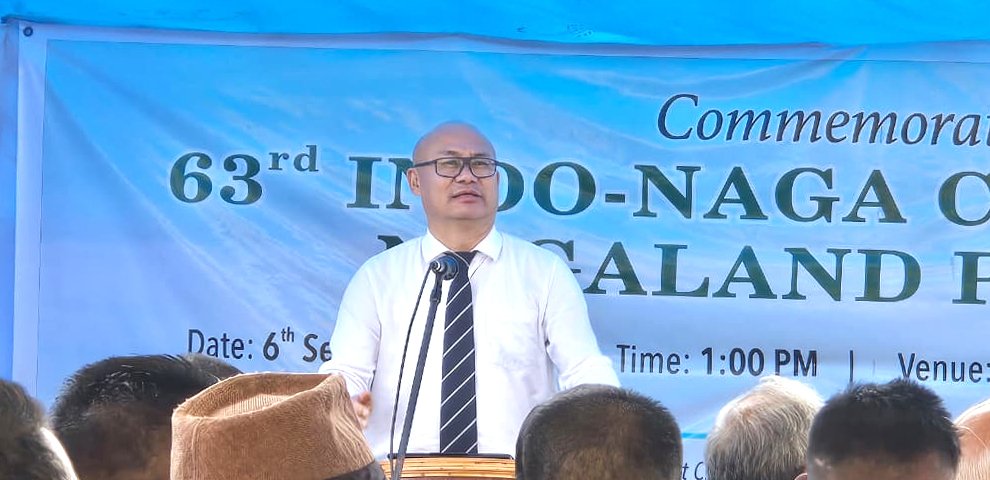
Angami said the ceasefire represented a recognition that military aggression was not the answer to the Indo-Naga issue, and maintained that a lasting peace settlement would require political will, intention, truthfulness and integrity to address violence in its different forms.
He also reiterated the FGN’s position that Nagas had never consented to being part of the Indian Union and described the Indo-Naga issue as one of occupation and aggression, calling on India to respect what he termed the historical position of the Nagas.
Referring to the Naga National Voluntary Plebiscite of 1951 and the Naga Yezhabo, Angami said the FGN’s position on sovereignty was rooted in the Naga people’s mandate and the traditional system of village republics.
He called on Nagas to strengthen village republics and traditional institutions while finding common ground beyond individual villages and regions.
“The Ao traditional governance of Putu Menden must support and advance the foundation and character of the nation,” Angami said, adding that traditional governance in other Naga regions should similarly strengthen the Naga national character.
He urged Nagas to work together by engaging with their land, villages and communities and called for greater cooperation and efforts to heal divisions.
“Let us pledge to listen and seek common grounds of cooperation, and work to heal wounds of division,” he said.
Angami also recalled the origins of the 1964 ceasefire, which was facilitated by the Peace Mission of the Nagaland Baptist Church Council. He paid tribute to the church leaders, elders and pioneering Naga national workers involved in the peace initiative and the political movement.
He said the rounds of peace talks following the ceasefire declaration took place at Chedema and Khensa, and recalled the presence of Naga and Indian delegations at the talks.
Reflecting on the significance of the Khensa Peace Talk Camp, Angami said national leaders, elders, people and international delegations had gathered at the site during the peace talks in 1965.
He also highlighted the contribution of ordinary villagers to the Naga movement, recalling the first Naga Home Guards who voluntarily joined the service from Khensa in 1955.
Angami said the sacrifices of such “unsung heroes” from Naga villages had helped shape the Naga story and should not be forgotten.
He concluded by calling on Nagas to remain committed to truth, cooperation and the pursuit of their political aspirations, and thanked the NBCC for continuing to commemorate the 1964 ceasefire.