
Veteran journalist Oken Jeet Sandham’s sixth book, The Naga Talks: Deadline, Deadlocks and the Search for a Solution, was officially launched by Minister for Power and Parliamentary Affairs KG Kenye in the state capital on Friday. The publication focuses on the long and complex history of political negotiations surrounding the Naga issue, including key milestones such as the 2015 Framework Agreement and the 31 October 2019 deadline that was set for concluding the Indo-Naga political talks.
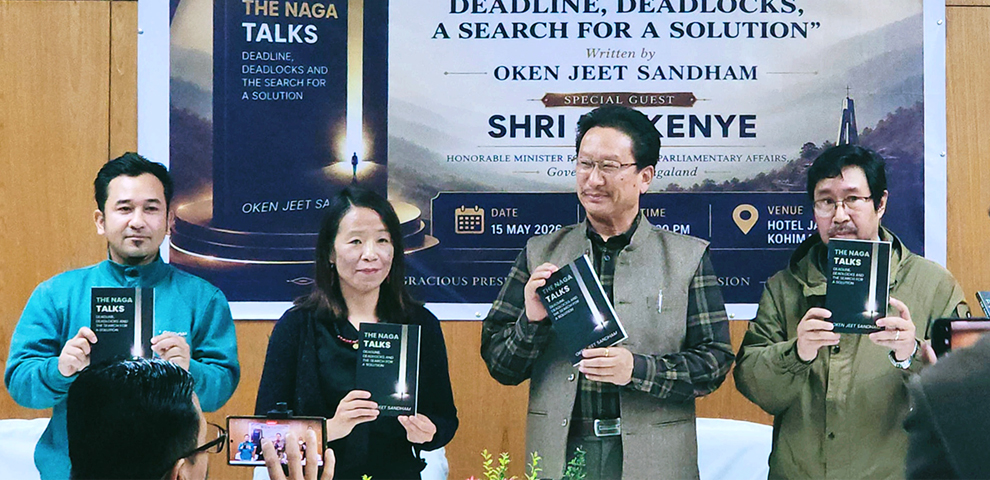
Speaking at the launch, author Sandham said the book documents “expectations, missed opportunities, political complexities, and the continuing search for a solution that is honourable, inclusive, and lasting.” He explained that his interest in the subject deepened after Prime Minister Narendra Modi met members of the Parliamentary Working Committee of the Nagaland Legislators’ Forum in New Delhi on 16 July 2015. Recalling the Prime Minister’s remarks, he said, “If peace comes, it must come in toto. Every single Naga person is important in bringing the solution.”
Sandham said these observations prompted him to closely examine the Government of India’s approach toward the Naga peace process. He further noted that the signing of the Framework Agreement between the Government of India and the NSCN (IM) on 3 August 2015 raised several questions regarding its contents, the absence of public disclosure, and the direction of the negotiations that followed.
According to Sandham, although the talks were “officially concluded” on 31 October 2019, the final outcome has not been made public. He said, “Years have passed. Political circumstances have changed. Governments have changed. Yet, the final settlement continues to remain unresolved.” He added that the peace process today appears to stand at a difficult and uncertain stage, raising questions about whether there is still sufficient political will and wisdom to move toward a meaningful resolution.
Launching the book, Minister KG Kenye said it offers “an insight into the recent and not so recent dialogues, the political negotiations that have taken place.” Referring to his personal relationship with the author, he added, “Oken Jeet, to me, is my brother-in-law. He married my cousin sister… He has merged into the Naga society, which has given him some sort of emotional attachment in the issues that confront us.”
The minister traced the origins of the Naga political movement to the 1929 Memorandum submitted to the Simon Commission. He described the decades-long journey as “97 years, in search of a very, very elusive aspiration, which seems inconclusive, unending, unceasing.” He further said, “Above all, the political issue has been most contentious, for which we are still struggling to arrive at a destination. In 100 years time, what awaits us is anybody’s guess. But the way things are developing around us, there is much hope,” while underlining the importance of proper documentation of historical events.
Kenye also observed that recording events accurately could help reduce confusion in society. He reiterated that the book provides “an insight into the recent and not so recent dialogues, the political negotiations that have taken place,” reflecting the author’s deep engagement with the subject.
Kohima Press Club president and poet Vishü Rita Krocha described the book as one carrying “a sense of high anticipation.” She said Sandham’s work is “synonymous with a deep, persistent, and analytical gaze into the heart of our political journey.” She further stated, “Oken Jeet is not merely an observer; he has been a chronicler of our times. His writing has consistently provided a window into the complexities of the Naga political issue.”
She added that the title itself serves as “a powerful summary of collective history,” capturing the urgency, delays, stalemates, and ideological challenges of the peace process. She noted, “‘The Search for a Solution’ is the heartbeat of the book, reminding us that despite the obstacles, the pursuit of a lasting and honorable peace remains the ultimate goal,” and stressed the value of such works in providing insights for policymakers, scholars, and young readers.
Chairing the programme, Menuse-O Max Marius said Sandham “began his stellar journalism career right here in Kohima with the Weekly Journal in 1987.” He said Sandham later worked with The Statesman and served as a stringer for the Hindustan Times. He also noted that Sandham edited The Northeast Herald and currently serves as Editor of the North East Press Service (NEPS), an independent online news agency based in Kohima. Sandham has authored several books, including Narendra Modi and the Naga Peace Accord and Modi Walking on Elusive Naga Peace. The programme concluded with blessings by Arjun Chetri, vote of thanks by Kopelo Krome, and attendance from MLAs, media fraternity members, and well-wishers.
The book is priced at Rs 500 and is available at Students’ Book Centre, PR Hill, Kohima.