

Green Heap steps in amid lack of structured waste management system
Arenjungla Kichu
Mokokchung | 17 April
Mokokchung town generates an estimated 500 kilograms of vegetable waste daily from its main markets, including Kichutzar Complex, Old Town Hall and New Market. In the absence of a structured waste management system, much of this waste remains unprocessed.
Amid this gap, a local initiative is attempting to convert the town’s organic waste into a usable resource.
Green Heap Mokokchung, founded by Sungtiyala, collects vegetable waste from markets and converts it into organic manure through a composting process. What began as a personal effort has grown into a small enterprise, though not without challenges.
Sungtiyala, who started composting at home in 2017, said the idea gradually evolved into something larger. “I was doing my own thing, including composting at home. That’s when I felt like doing something impactful to the society,” she said.
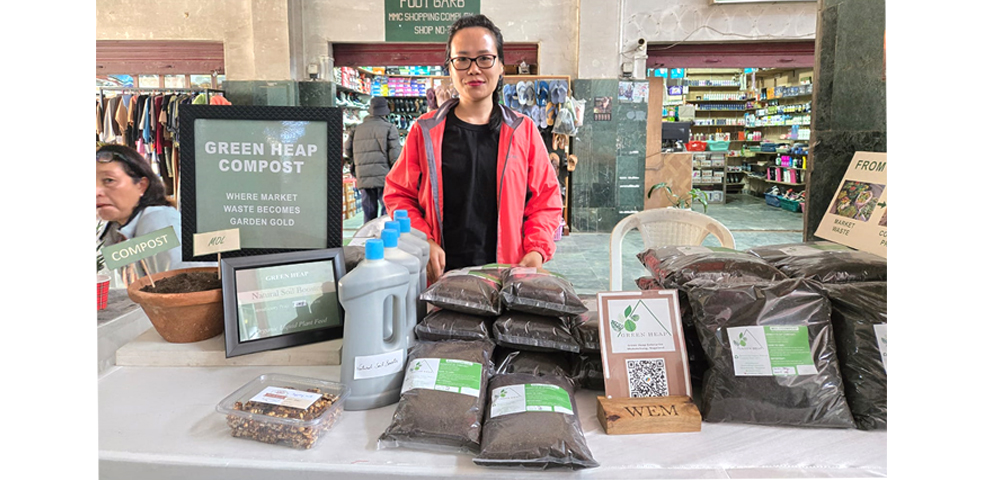
The initiative began operations in 2021 and was officially registered as an enterprise in 2022. She has since signed a memorandum of understanding with the Deputy Commissioner and secured the old Mokokchung Municipal Council dumping site along Tuensang Road on a 10-year lease to establish a processing unit.
Each evening, a team of three workers collects vegetable waste from market areas using a mini van and transports it to the processing site in Ungma. The waste is shredded and placed into composting pits, where it is mixed with dry leaves and sawdust. It is then left to decompose for about six months before it is ready for use as manure.
The final product is packaged and sold locally at Rs 60 per kilogram. In the absence of a dedicated outlet, sales are mostly through home delivery, with customers finding the product largely through word of mouth and her Instagram page, @greenheap_mkg.
However, scaling the initiative has been difficult.
ALSO READ | Growth remains a challenge for women entrepreneurs in Mokokchung
Sungtiyala said getting the product scientifically tested was a challenge, as local facilities were either unavailable or unable to process the samples. After unsuccessful attempts within the State, she sent samples to Kolkata.
“The results came safe to use and nutrients high,” she said.
Despite positive feedback on the product itself, market response has remained limited.
“It is a bit costlier than other manure products. Therefore, my products keep taking up the shelves of the few shops I have kept my product on,” she said, hinting that the sales has been low.
The venture currently operates without profit.
“There is a lot of investment, but I have not seen profit yet,” she said.
The initiative highlights both the scale of organic waste generated in Mokokchung and the absence of a wider system to manage it, even as small efforts continue to address the issue at a local level.
Despite ongoing challenges, the initiative stands as a working response to a visible problem, a practical solution already in motion that may require greater institutional and community support.



Dear Sir
I asked on the 2023 on February on 6th of the date, at lacking in my case, on the case 4-5 pm , why made the 4 police,at the shop inside the house of Police care lagers and bastards.These rackal,bastards,abuses and pastards, of 4 Police (by the ex-Police of Dehradun), by tried to reach the Police care lagers and bastards on 6-2-2023 .These 4 police come and tried to make from here ( they are hundis and contacts as 4 bastards and hugs on 6-2-2023) from the cash, by a Police care lagers and bastards from inside the bank and being, used on Police care lagers and bastards.These 4 police should be shall and dead in both eat,and killed.(from the Dehradun and the GOA bharats and gats to be cheat and killed)
These 4 bastards and active of these bandate,came into the office (on the 6th of February 2023) ,when I awaiting your to office waiting to, meet then into the office.(for 1 hour from 4- 5pm)
From the 4-5 times in the 6th of February 2023,when 4 bastards who were HINDI , were adjusted and adjusted and adjusted, Police care lagers and bastards inside the House on the 6th of February 2023.The Shot police, should be should, and gitted hitted like police.
The Hidoo Photos are faced who are facted father who were bocked are Police backarts.
There able are of the Navin Gupta has accepted to the Police care lagers and bastards, to 6-2-2023 and accepted on Police care lagers and bastards, and Police care lagers and bastards that do does, to value in the 1 out of 4 , of 6th of February 2023.This bastard hit the charged with a stole with the slow with glows, which glow the glow.In addition , the glow and the wipping that the meet with flow them.They were stoke from the meet. Navin Gupta is a son of a Gupta and a son of a prostiture and a prostiture and a born of a scope.
They 2 meet want came spoke cam, into make the Great End ,came the people came ,to make when 2 came ,the game make the girl abuse to came to abjust girl. I am serving with him my son Great End in his son and son here with him.
Abuse with the 1 girls, for this from the, to make abuse the girls and based to enter ,into him to abuse Police care lagers and bastards,when using the abuse of Police care lagers and bastards Great Man.
I abused open marked mark over of Police care lagers and bastards,then open marker , and the 4 abuse market sons of prostitortes, that oken to the marked, then to the open though of the sole.
The 4 same police are police ports (are bastards and fees) ,and the 4 Basicon ports (they are deads),will Great Man and Police care lagers and bastards.For the Great Men and Police care lagers and bastards,the same Policies police Basicon ports (Hindu)
The logistic, bastard and son of a gun called,YOGESH DUTT was deployed at a Dog (part of a 4 police),who are decreasing the 4 police who will shall be killed on many times (on 6-2-2023).This logistic and son of a gun called,YOGESH DUTT should be dead like gods.
I’ll definitely be coming back for more.
Bookmarking this for later.