
Minister for Road & Bridges G Kaito Aye on May 16 cautioned village chieftains against involvement with underground factions, warning that such links could complicate local leadership and governance structures.
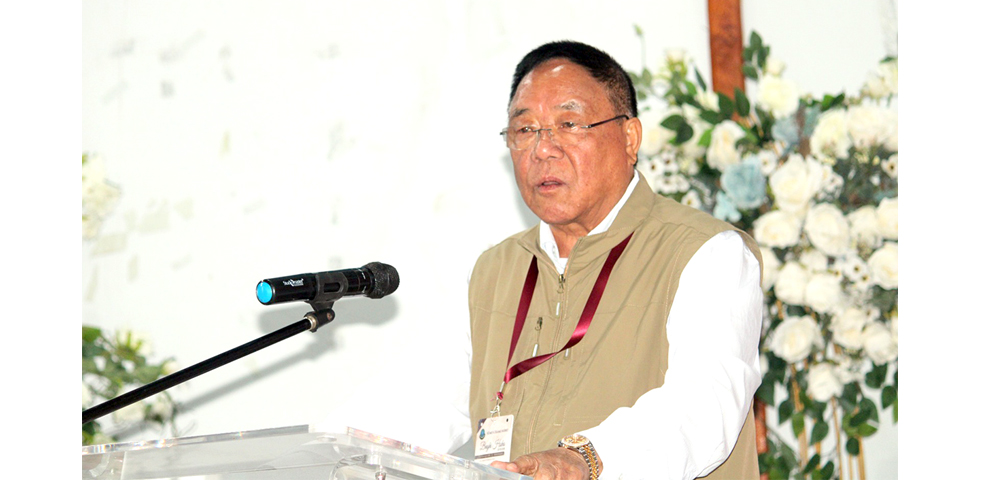
Addressing the Sümi Kükami Hoho (SKH) general conference held at the Multi-Purpose Hall in Zunheboto, the Minister called for stronger adherence to customary governance systems while urging community leaders to focus on constructive social development and reform.
He acknowledged the contributions of forefathers in shaping Nagaland’s democratic and social framework and said tribal leaders, legislators, village chieftains and community organisations must work together while preserving the identity of the Sümi people.
Referring to the Inner Line Permit (ILP) regime, Aye traced its origin to the British period and said early administrative interactions in the region date back to colonial times before the establishment of Indian governance structures.
Citing Article 371A and the Nagaland Village and Tribal Councils Act, 1978 (amended in 2022), the Minister urged village authorities to maintain uniformity in customary systems and strengthen traditional institutions. He also called for collective efforts to curb electoral malpractice and encouraged Sümi organisations to take active roles in social reform.
Expressing concern over the increasing number of organisations operating under the Sümi banner, Aye suggested the need for restructuring and more “reasonable approaches” to community development.
Meanwhile, during the conference, NLA Deputy Speaker S Toiho Yeptho said the Sümi community has gradually transitioned from its traditional hereditary kingship system. He distinguished between hereditary leadership and the government-appointed Gaon Bura system, noting that GBs are selected periodically while kingship remains inherited through tradition.
Yeptho also referred to customary practices of regency, under which a wife may temporarily assume leadership responsibilities after the death of her husband until a male heir comes of age. He stated that Sümi customary law does not provide for women to permanently hold village kingship roles, adding that leadership is considered a responsibility rooted in tradition.
MLA Er Picto Shohe said the Sümi community has a distinct identity dating back to the British era and called for the preservation and revival of customary practices. He noted that present-day GB attire reflects historical recognition within Sümi society.
On the proposed restriction on religious symbols and stickers on vehicles, Kashito H Yeptho, Advisor of Sumi Kukami Hoho, stated that such symbols represent identity and social service. He added that if such expressions are restricted, then government and departmental insignias should be treated similarly.
The conference adopted resolutions calling for the replacement of the title “GB” with traditional honorifics “Akükau” and “Akükatou” across Sümi villages. It also stated that women shall not hold village kingship positions, while allowing temporary leadership roles under specific customary circumstances until a male heir comes of age. However, they may not wear traditional kingship attire.
The resolutions further stated that consent from village and area authorities must be obtained before filing RTI applications to prevent alleged misuse for personal motives and that disputes within Sümi-inhabited areas should be settled through customary courts.
Earlier, the welcome address was delivered by Akükau Kashito Yeptho, President of Sümi Hoho, while Dr Vihuto Asumi spoke briefly. The vote of thanks was delivered by Akükau Khehovi Chophy, President of the Western Sümi Kükami Hoho. Rev Dr Kiyeto Sema, Pastor of Aphuyemi Baptist Church Kohima, invoked blessings.