

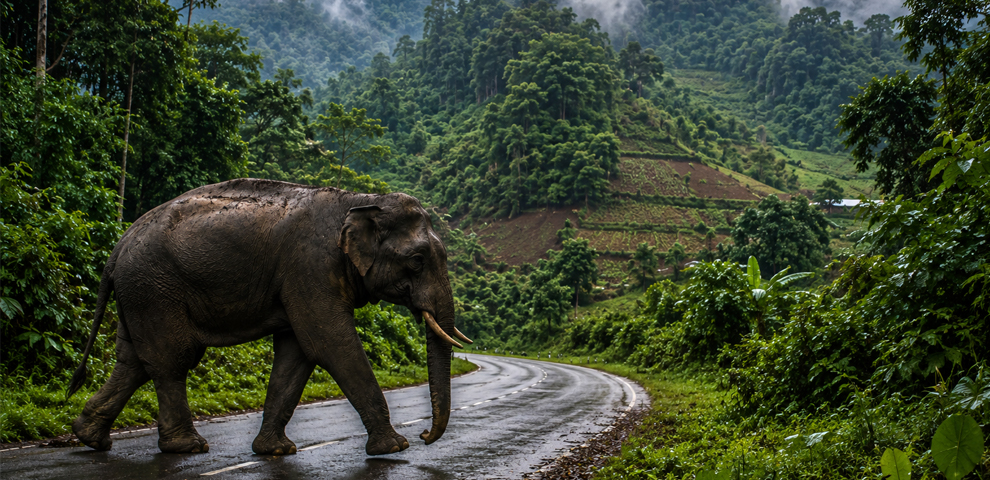
Officials urge immediate public reporting following recent elephant sightings along the Khar-Mangkolemba road
The newly created Doyang Wildlife Division has begun operations amid rising reports of human-wildlife conflict in districts including Mokokchung, which officials now identify as one of Nagaland’s major human-elephant conflict hotspots.
But even as the new division begins overseeing Wokha, Zunheboto and Mokokchung districts, officials admit the department is still operating with limited manpower, minimal infrastructure and temporary response measures at a time when wildlife conflict in the region is increasing.
“At the moment, we have only one deputy ranger,” Jongponglemba, Incharge of the Doyang Wildlife Division, told Mokokchung Times.
“People are expecting watch towers, solar panel lights and emergency funds. But unfortunately, at the moment, crackers are all we can provide,” he admitted.
The Doyang Wildlife Division officially became a full-fledged wildlife division following a government gazette notification issued on March 26, 2026, and was formally inaugurated in April. Prior to that, the office functioned as a plantation division.
Previously, Nagaland’s wildlife management system was divided between only two wildlife divisions: Kiphire, which covered the eastern zone, and Dimapur, which oversaw the remaining districts.
“Considering the jurisdiction, it was difficult to manage in terms of manpower, logistics and response effectiveness,” Jongponglemba said.
The new division was created to improve response time and monitoring in districts increasingly reporting wildlife-related incidents, particularly human-elephant conflict.
According to the official, Wokha remains the state’s biggest hotspot for human-elephant conflict, followed by Mokokchung.
“The hotspots of those conflicts are in Wokha and second is Mokokchung,” he said.
Recent reports of wild elephant movement along the Khar-Mangkolemba road have further heightened concern in the district.
At present, the division relies largely on temporary mitigation measures such as crackers and king chilli-based deterrents to drive elephants away from human settlements.
The official also acknowledged the limitations of current response mechanisms and said the department’s immediate focus remains on mitigation rather than long-term resolution.
“See, a solution is not possible. Human-elephant must coexist,” he said.
He explained that shrinking elephant habitats and fragmented wildlife corridors caused by expanding human activities have increasingly pushed elephants into human-dominated areas.
“There has been a big shrinkage in elephant habitat with the rise of human activities in terms of agricultural or horticultural farms and roads,” he said.
Officials say elephants often continue to follow traditional movement corridors that may now pass through settlements, farms and roads, increasing the likelihood of encounters.
“What human settlements and activities have done is we have fragmented their habitats and there is a disconnect in their corridor,” he added.
Apart from elephant conflict, the new division has also begun responding to other wildlife-related incidents. A few weeks ago, the department received reports of a leopard sighting in the Tzürang area, leading to a site inspection by wildlife staff.
While the department says a long-term action plan is “in the pipeline,” officials acknowledged that the scale of the conflict is increasing faster than existing systems can fully address.
“It is indeed coming to a point where losses cannot be compensated, be it the crops cost and human cost, if unfortunate,” Jongponglemba said.
For now, officials say immediate reporting by residents remains critical whenever wildlife sightings occur so that field staff can respond quickly.
“The moment we receive the reports, we send our field staffs to the spot. Therefore, we would really like to encourage people to report it to the nearest forest officer,” he said.