
Difficult terrain, scattered schools and uneven teacher deployment emerge as key challenges
The National Education Policy (NEP) 2020 is a national framework, but its implementation in the Northeast comes with a set of challenges ranging from difficult terrain and low population density to declining enrolment, teacher deployment and inadequate infrastructure.
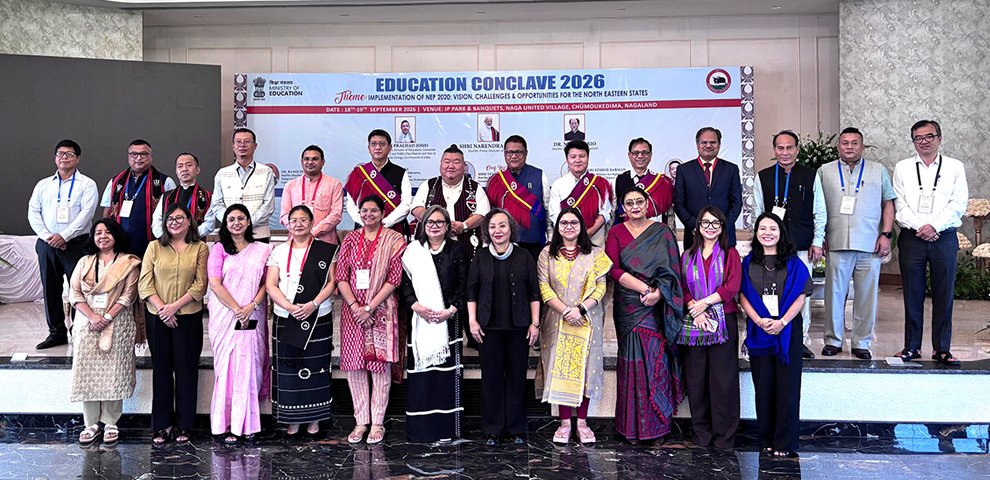
At the ongoing two-day North East National Education Policy Conclave in Chümoukedima, Mizoram Education Minister Dr Vanlalthlana pointed to the challenges facing school education in the state, even after Mizoram was declared India’s first fully literate state in 2025.
He cautioned that literacy was only the starting point and highlighted high dropout rates, uneven teacher distribution, declining enrolment and inadequate infrastructure as some of the concerns facing the state.
Citing UDISE+ 2025-26 data, Vanlalthlana said Mizoram had 3,965 schools, 284,270 students and 25,282 teachers, with a pupil-teacher ratio of 11.2, compared to the national figure of 24.1.
However, he pointed to disparities in teacher deployment, saying nearly 55 per cent of students were in the foundational and preparatory stages, while only around 25 per cent of teachers were deployed at those levels.
Mizoram’s primary dropout rate, he said, stood at 6.35 per cent against the national average of 1.5 per cent. He also said 1,655 of the state’s 2,563 government schools had fewer than 50 students.
Vanlalthlana said Northeastern states also faced declining enrolment in government schools, fragmented school networks, inadequate digital connectivity, shortages of trained faculty and difficulties in providing matching funds under centrally sponsored schemes.
He called for a terrain-based school accessibility index instead of distance-based norms, along with separate construction and staffing provisions for hill areas and greater support for small schools in sparsely populated regions.
On higher education, Vanlalthlana proposed a jointly governed multidisciplinary university for the Northeast, with campuses across states, a shared faculty pool and special funding provisions for smaller states.
He also suggested a forum of Northeastern education ministers under the North Eastern Council, supported by a common technical secretariat, to facilitate joint submissions and coordinated planning.
Tripura Minister for Panchayats, Higher Education and General Administration Kishor Barman stressed the need to translate NEP 2020 from policy into classroom practice.
“Education must move beyond examination marks towards meaningful learning, critical thinking, skills and social responsibility,” he said.
Barman said the Northeast’s linguistic, cultural and geographical diversity required an approach that combined local roots with global aspirations, allowing students to remain connected to their traditions while acquiring skills in artificial intelligence, digital technology, research, innovation and entrepreneurship.
He said cooperation among Northeastern states and the sharing of best practices could help accelerate implementation, adding that the success of NEP 2020 would depend on how effectively it was adapted to ground realities.
Arunachal Pradesh MLA and Adviser to the state’s Higher and Technical Education department, Mutchu Mithi, highlighted geographical constraints, shortages of human and financial resources and the challenges of providing infrastructure across difficult terrain.
He said the Northeast needed to be considered differently from plains-based regions while formulating education and infrastructure policies, particularly because of its terrain and low population density.
Mithi also stressed the importance of digital literacy and critical thinking, saying students needed to be able to distinguish facts from misinformation as access to information increased.
Referring to Arunachal Pradesh’s financial position, he said the state was facing an estimated annual shortfall of around Rs 4,000 crore following changes in its share of central tax devolution under the 16th Finance Commission.
Assam Education, Tribal Affairs and Information Technology Minister Dr Ranoj Pegu said the state had been restructuring school education in line with NEP 2020, including merging the elementary and secondary education directorates into a unified School Education Directorate and consolidating examination boards.
Assam has adopted the 5+3+3+4 school structure and expanded mother-tongue instruction at the lower primary level to 14 languages, Pegu said.
The state is also working to integrate Anganwadi centres with nearby lower primary schools to strengthen the foundational stage for children aged three to eight years, he said.
Pegu, however, stressed the need to broaden educational opportunities beyond competitive examinations. According to him, only around 2.6 per cent of students in Assam pursued medical, engineering or similar professional education, making it necessary to focus on the employability of the remaining students.
On higher education, Pegu said Assam was the first state in the country to introduce the four-year undergraduate programme in 2021, with its first batch reaching the seventh semester this year.
However, he said around 50 per cent of students who enrolled in the first semester had not progressed to the seventh semester due to challenges relating to faculty availability, infrastructure and student retention.
Pegu also called for greater integration of vocational skills into university curricula. He suggested that disciplines such as English could offer specialised diploma programmes in areas such as content writing, translation, creative writing, proofreading and copy editing.
He also urged universities to incorporate 21st-century skills, including critical thinking, creativity, collaboration, leadership, problem-solving, media literacy and digital literacy, into their curricula to improve employability.
Nagaland Higher Education and Tourism Minister Temjen Imna Along said implementation of the policy required meaningful participation from policymakers, educationists, administrators and academic institutions, particularly at a time when conventional degrees were no longer sufficient to guarantee employment.
He emphasised the importance of critical thinking in education and called for discussions on incorporating the region’s cultural and religious traditions into academic discourse.
Referring to Nagaland’s Christian-majority population and the role of churches in the state’s social and economic life, Along urged academicians to examine the scope for including Christian studies in university curricula.
He also called for wider academic discussions on theological institutions and the inclusion of different faith traditions in education, while stressing the need to approach such matters through constructive and critical discourse.
Along said the conclave should culminate in a clear resolution incorporating inputs from participating states and addressing the practical challenges of implementing NEP 2020 in the Northeast.