

Jamir highlights disconnect between external frameworks and local socio-cultural systems in policy design
“Just because we are in the corner of India does not mean we cannot contribute anything. We have a lot to contribute,” said Amba Jamir, Senior Policy Analyst and development strategist based in Guwahati, Assam, while speaking at a two-day national conference held at Fazl Ali College, Mokokchung, Nagaland on April 15.
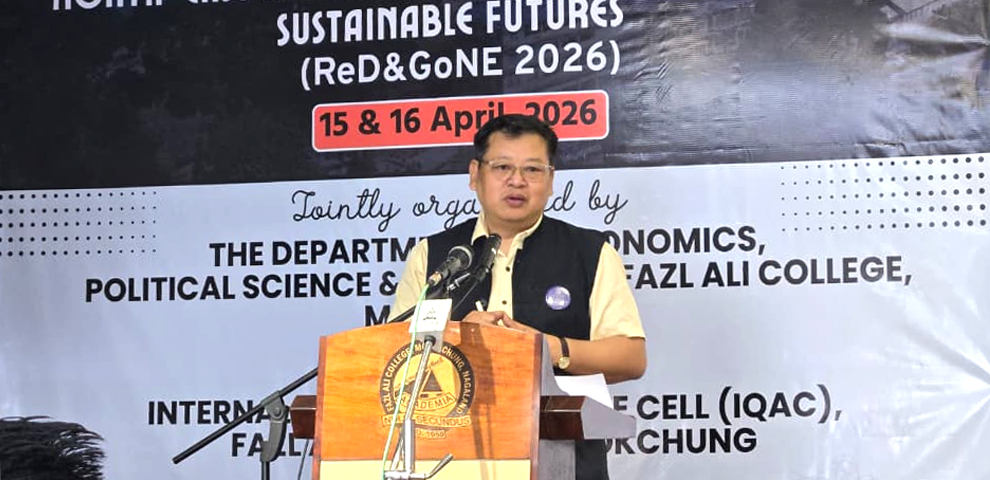
Addressing the theme “From Frontier to Pivot: Reimagining Development and Governance in Peripheral Landscapes,” Jamir questioned the State’s continued reliance on outside planning, saying this has weakened local ownership of policies.
“We always have a habit of believing that Delhi will plan for us. We are too much dependent on consultancy,” he said, adding that such dependence often leads to policies that do not reflect realities on the ground.
Jamir argued that Nagaland has its own strengths, including what he described as “ecological intelligence” knowledge developed by communities over generations, such as understanding seasonal patterns and predicting rainfall, which could guide development planning but are often ignored.
He also pointed to the diversity within Naga society, saying, “We have different tribes, clans and even within the different clans, we have kinship,” stressing that such social structures are rarely considered in policy design.
Highlighting what he described as “structural misalignment,” Jamir said many policies designed outside the State do not fit local realities, particularly in areas such as land use, customary practices and governance systems.
He noted that Village Councils are often overburdened with implementation responsibilities without adequate empowerment. Referring to reliance on external experts, he said, “External frameworks are good… maybe from where it got originated.”
Jamir said the marginalisation of local systems remains a major concern. “We don’t seem to have a vision as a state, a village or a church,” he said, adding that regions like Nagaland should not be treated as “objects of development” but as sources of institutional development.
He further pointed out that policies across the North East are often homogenised, ignoring community institutions for administrative convenience.
Citing examples, Jamir claimed that Vision 2047 for the North East was framed without consulting state governments or local bodies. He also questioned approaches to shifting cultivation. “If shifting cultivation was that bad, how are more than 300 indigenous communities just doing fine across the world?” he asked.
Questioning the recognition of traditional institutions, he asked whether bodies such as Putu Menden are formally recognised by the State. “We are just told to implement this and this. That’s why many policies fail because they are not based upon realities of the locals such as land use,” he said.
Jamir said the gap between statutory and customary systems has resulted in a lack of accountability. “Currently, there is no relation between statutory and customary bodies. There is a systemic erosion of traditional institution,” he said.
Calling for change, he stressed the need for “hard-hitting shifts,” including moving from program delivery to building institutions that reflect local realities.
He also called for recognition and integration of traditional systems. “Line must be drawn between state recognised bodies and traditional bodies and a bridge must be made between these two,” he said.
The conference was organised under the theme, Reimagining Development and Governance in NorthEast India: Pathways for inclusive and sustainable futures (ReD&GoNE 2026). It was jointly organized by departments of Economics, Political Science and Sociology, Fazl Ali College and was sponsored by Internal Quality Assurance Cell (IQAC), FAC, Mokokchung.