

The Press Information Bureau (PIB) organised a media workshop, ‘Vartalap’, on Cyber Suraksha Bharat at Hotel Saramati, Dimapur, on Tuesday, focusing on legal issues in journalism and the growing threat of cybercrime in Nagaland.
The workshop featured two technical sessions on ‘Legal Perspective on Defamation and Journalistic Responsibilities’ and ‘An Overview of Cyber Crime in Nagaland’. Dimapur Press Club president Henlly Phom Odyuo attended the programme as Guest of Honour.
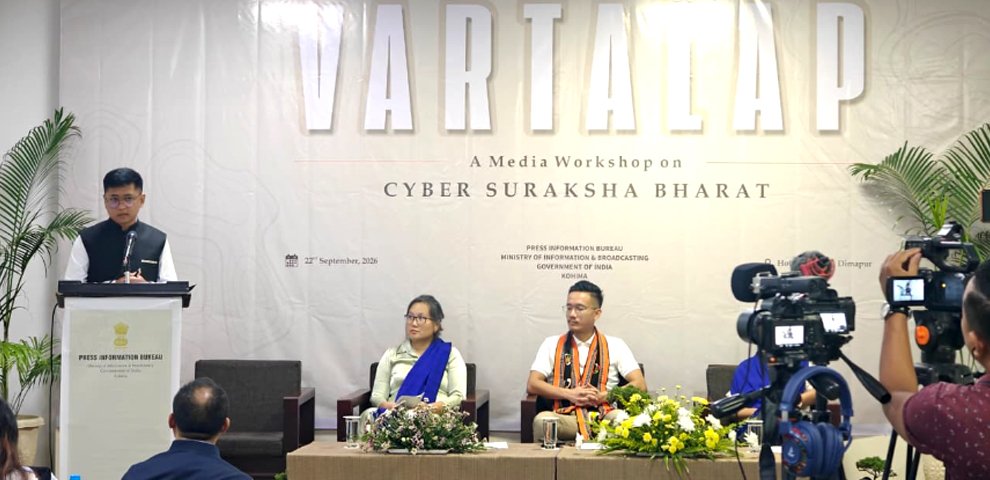
Addressing the session on defamation and journalistic responsibilities, Public Prosecutor, Dimapur, Temsunaro Jamir explained the legal distinction between civil and criminal defamation under Section 356 of the Bharatiya Nyaya Sanhita (BNS), 2023.
Jamir stressed the importance of accuracy, fairness, independence and accountability in journalism. She cautioned journalists against conducting parallel media trials that could prejudice judicial proceedings and highlighted the constitutional presumption of innocence until guilt is established.
She also emphasised strict compliance with the Protection of Children from Sexual Offences (POCSO) Act, particularly the legal requirement to protect the identity of minor survivors.
Advising journalists on reducing legal risks, Jamir stressed the importance of documenting a subject’s “Right of Reply”, retaining raw source materials and verifying information in good faith and in the public interest.
In the session on cybercrime, Kihika Chishi, NPS, Officer-in-Charge of the Cyber Crime Police Station at Police Headquarters, said 80 to 85% of reported cybercrimes in Nagaland originate from Dimapur and Kohima.
He said cybercrime often exploits human emotions, trust and fear through social engineering methods, including phishing, smishing, vishing, digital arrests, investment scams and fake loan applications.
Chishi urged media personnel and citizens to practise cyber hygiene by enabling multi-factor authentication, verifying sources before clicking or sharing content, and reporting financial fraud immediately through helpline 1930 or the cybercrime.gov.in portal.
He also highlighted Section 353 of the BNS concerning the spread of false information and rumours, stressing the need for proper verification before publication.
The workshop concluded with an interactive question-and-answer session between media practitioners and the resource persons.